- +1 (602) 922-5990
-
This email address is being protected from spambots. You need JavaScript enabled to view it. - Mon - Fri 8:00a - 5:00p AZ


-

The organizations that lead in 2027 will not be those that avoid disruption. They will be those designed to absorb disruption, protect critical outcomes, recover intelligently, and adapt faster than the conditions around them change.
-
Executive perspective: Compliance tells an organization what it is expected to do. Confidence comes from knowing, through evidence, testing, measurement, and experience, that the organization can actually do it when conditions become difficult.
For years, organizations have responded to risk largely through a compliance lens. Policies are written. Controls are documented. Assessments are completed. Business continuity plans are maintained. Vendors are reviewed. Recovery procedures are recorded. Audits are performed. Findings are tracked.
All of these activities matter.
-
Supply chains have always faced disruption. What has changed is the speed, complexity, interconnectedness, and potential business impact of that disruption.
A supplier problem that once created a purchasing inconvenience can now interrupt production, delay customer services, expose sensitive information, disrupt critical technology, create regulatory concerns, or stop an essential business service altogether.
-
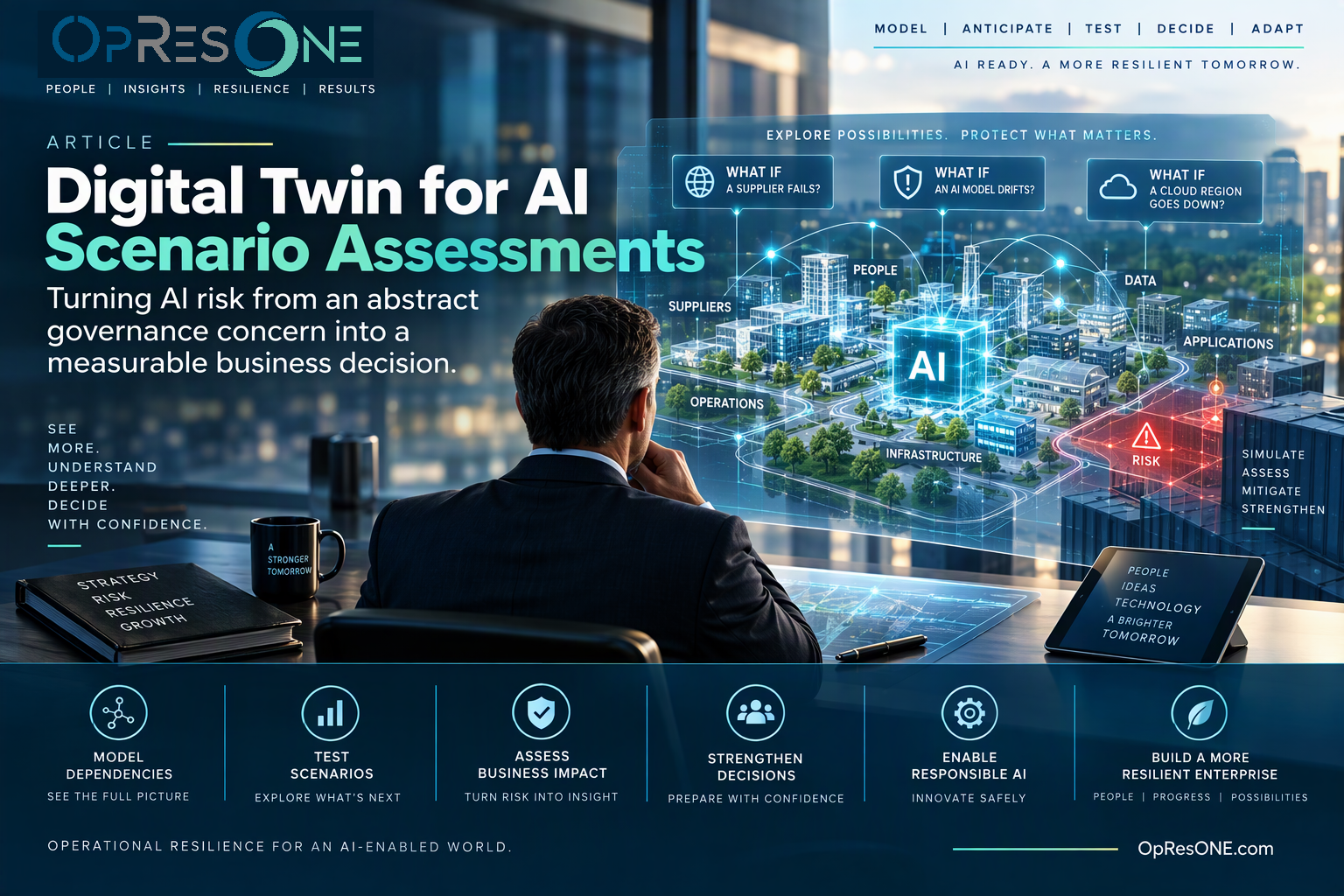 Artificial intelligence is moving rapidly from experimentation into the operating fabric of the enterprise. AI systems are influencing customer interactions, cybersecurity decisions, financial analysis, fraud detection, supply chains, software development, workforce productivity, risk management, and increasingly, decisions that once depended entirely on human judgment.
For executives, that creates extraordinary opportunity. It also creates a difficult new question.
-
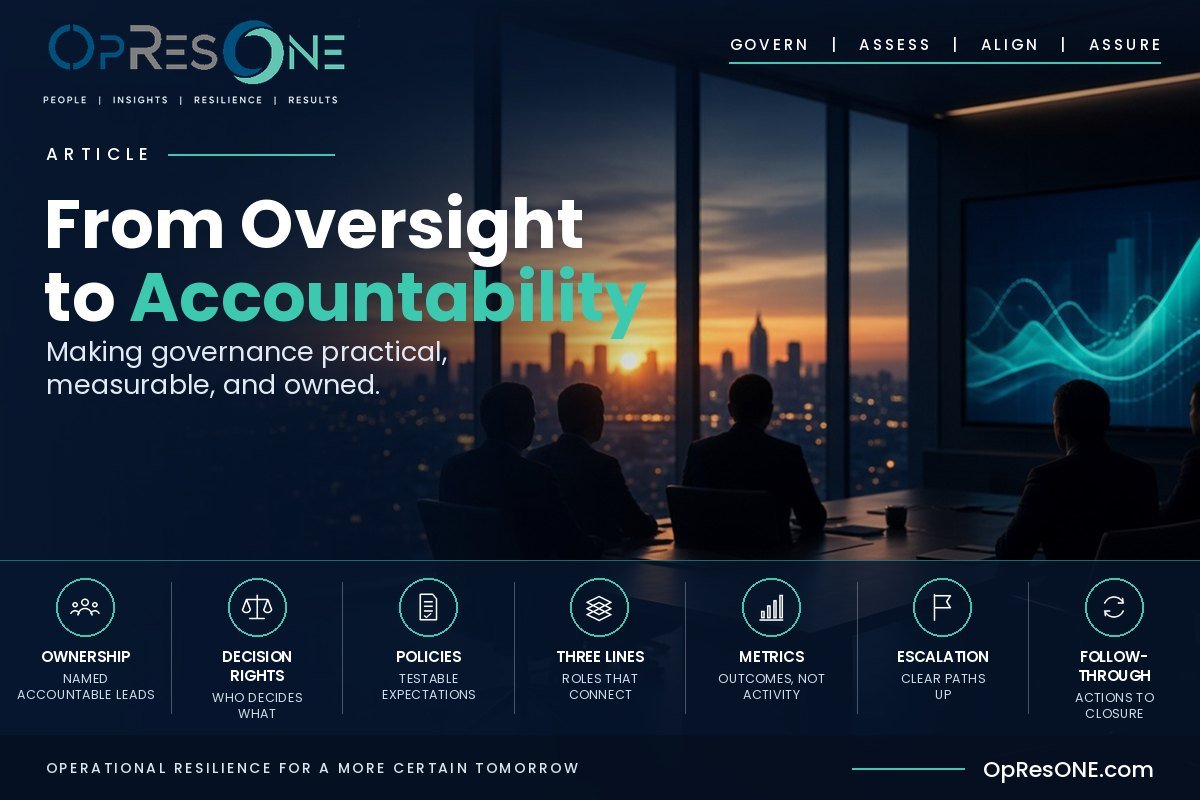
Most boards and executive teams would say their organization has governance. There is a charter, a committee calendar, a risk register, a set of policies, and a steady flow of reports. Yet when a serious disruption, a regulatory inquiry, or a failed control lands on the table, the same question tends to surface: who actually owned this decision, and how did we know it was working? Oversight that cannot answer that question is activity, not governance.
This article explains how to turn governance from a set of structures into a practical system of accountability, one where decisions have named owners, expectations are written down, and leaders can see evidence that the organization is doing what it says it does. It is written for directors, executives, and the GRC leaders who support them.
-
Most organizations have a risk appetite statement. Far fewer can point to a recent decision that it changed. The statement is approved by the board, filed with the risk framework, and revisited once a year, while the choices that shape the organization's risk profile, such as which projects to fund, which suppliers to use, which products to launch, and which systems to retire, are made elsewhere, on different timelines, by people who may never have read it.
This article explains how to bring risk appetite out of the framework document and into everyday business decisions. It is written for chief risk officers, executives, and GRC leaders who want risk management to inform choices before they are made, not explain them afterward.
-
 Every compliance program eventually produces a checklist. Requirements are listed, controls are mapped, owners tick boxes, and the audit file fills up. The checklist is useful, but it answers a narrow question: did we do what we said we would do? It rarely answers the question executives, auditors, regulators, and customers increasingly ask: how do you know your controls actually work?
This article explains how to move from checklist compliance to evidence-led control assurance, an approach that tests whether controls are well designed and operating effectively, and that produces evidence strong enough to rely on. It is written for compliance leaders, internal auditors, and the control owners who carry the day-to-day load.
-
Many organizations now run two important programs side by side without connecting them. One is AI governance: the policies, committees, and risk assessments that decide how artificial intelligence may be developed, bought, and used. The other is operational resilience: the discipline of keeping critical services running through disruption. They are often staffed by different people, report to different executives, and use different vocabularies.
That separation made sense when AI sat at the edges of the business, in pilots and productivity tools. It makes less sense now that AI models help route customer calls, flag fraud, schedule maintenance, draft communications, and prioritize work queues. When AI becomes part of how a critical service is delivered, its failure becomes a resilience problem, and resilience planning that ignores it has a blind spot.
This article explains why the two disciplines need each other and how leaders can connect them without building another layer of bureaucracy.
-
"There will be a human in the loop." It is one of the most common reassurances offered when organizations deploy artificial intelligence, and one of the least examined. A person somewhere in the process is expected to catch errors, prevent harm, and take responsibility. Yet in practice, that person may be reviewing hundreds of AI recommendations an hour, may lack the information to judge them, may have no real authority to overrule them, and may have learned through experience that the AI is usually right.
In those conditions, human oversight becomes a formality. The human signs off, the AI effectively decides, and accountability becomes harder to locate when something goes wrong.
Meaningful oversight is achievable, but it has to be designed. This article explains how to define review and intervention points that work: where to place them, what the people in them need, and how to know whether oversight is real.
-
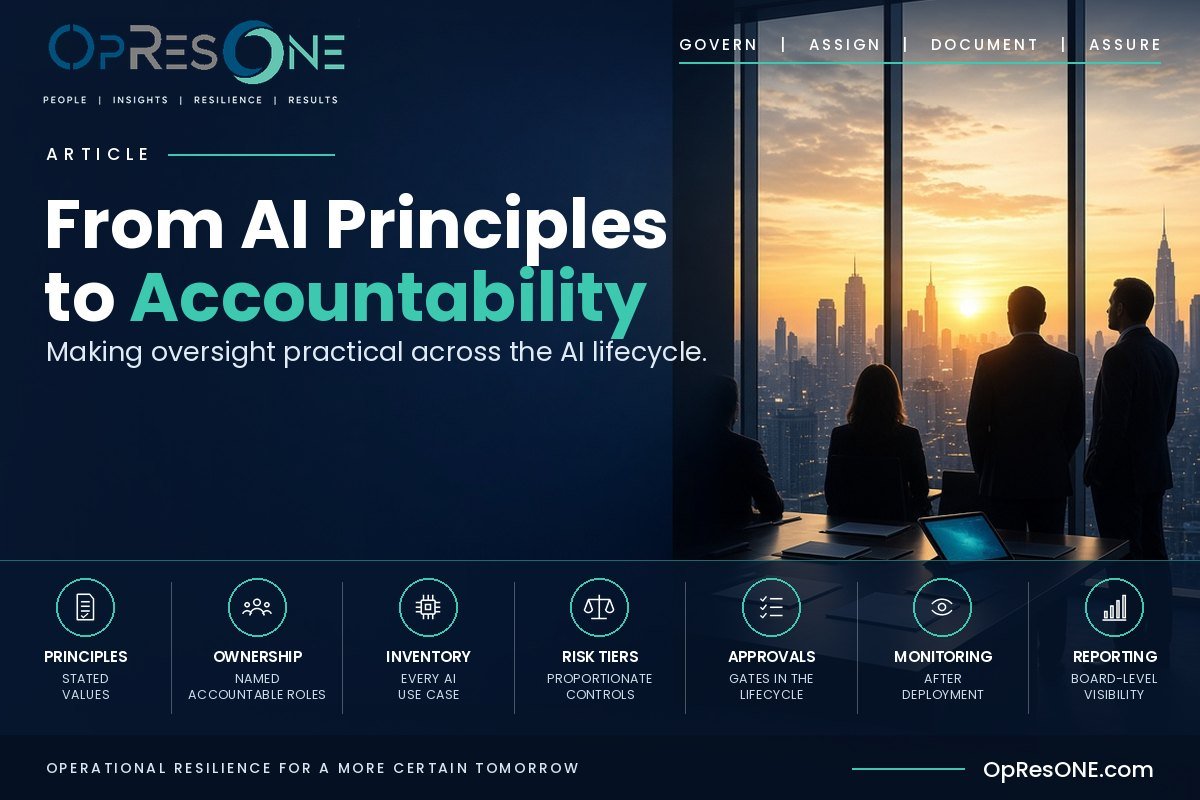
Over the past several years, many organizations have published statements of AI principles. They commit to fairness, transparency, privacy, safety, and human oversight. These statements are a reasonable starting point. They signal intent to employees, customers, and regulators, and they give teams a shared vocabulary.
But principles do not govern anything on their own. A commitment to fairness does not tell a product team which tests to run before launching a credit model. A commitment to transparency does not say who decides what customers are told when AI is involved in a decision. A commitment to human oversight does not specify who can stop a system that is behaving badly. Between the principle and the practice sits a gap, and that gap is filled either by deliberate accountability or by assumptions.
This article explains how to turn AI principles into practical accountability that works across the full lifecycle of AI systems, from the first idea to retirement.
-
Most organizations already collect more operational data than they use. Applications write logs, infrastructure reports metrics, security tools raise alerts, cloud and SaaS providers publish service status, and business systems record every transaction. Yet when a disruption arrives, leaders often learn about it from a customer complaint, a social media post, or a call from a frustrated business unit. The signals were there. They were simply not connected to the services that matter, not interpreted in time, or not routed to someone with the authority to act.
Telemetry for proactive resilience means ingesting and analyzing real-time and near-real-time data across your environment to detect changes, identify emerging risks, and take preventive action before disruption escalates. This article explains what operational telemetry is, how to connect it to important business services and impact tolerances, and how to turn live signals into early insight that supports better decisions. It is written for operational resilience leaders, CIOs, and the risk and technology teams who support them.
-
Organizations want their customers, employees, regulators, and boards to trust the AI systems they use. Trust, however, cannot be requested. It has to be earned, and in a governance context it is earned through evidence: documented, verifiable information showing that an AI system was designed responsibly, tested appropriately, operates as intended, and is overseen effectively.
Many organizations have pieces of that evidence. A data science team has validation results. A vendor has supplied a technical summary. A risk team has completed an impact assessment. A monitoring dashboard tracks some performance metrics. But the pieces often sit in different places, follow different standards, and stop at the moment of deployment. When someone asks a direct question, such as "How do we know this model is still performing fairly?", assembling an answer takes weeks, if it can be done at all.
This article sets out how to connect testing, monitoring, and assurance into a continuous chain of evidence that supports trust in AI over its full life.
-
A life-sciences organization can have validated equipment, approved procedures, and a quality unit and still be unable to release a batch, complete a critical test, or keep a multi-site laboratory network running if a contract manufacturer, a specialized testing lab, a cloud laboratory system, or a model used in development or quality cannot perform. In that moment the problem is not only a supplier-management finding. It is a continuity problem, a quality problem, and, where models are in the path, an AI-governance problem.
Life sciences is not a single regulatory silo. Drug and biological product manufacturers, blood and biologics laboratories, and medical-device firms live under different Food and Drug Administration frameworks, and many also sell or operate in the European Union. This article does not treat those frameworks as interchangeable, and it does not invent client or facility examples. It asks how third-party risk and AI should be governed so that testing, manufacturing, and release can continue when a partner or a model fails.
-
Most organizations have a process for vetting suppliers. Before signing a contract, a provider completes a questionnaire, submits policies and certificates, and perhaps shares a summary of its business continuity plan. Procurement and risk teams review the responses, score the provider, and file the results. The relationship begins, and the file is revisited at renewal.
That process has value. It screens out providers with obvious weaknesses and creates a record of what was promised. But it rarely answers the question that matters most when a critical provider is disrupted: can this provider actually keep delivering, or recover quickly enough, to keep our critical services within acceptable limits? A questionnaire records what a provider says it can do. Resilience depends on what it can demonstrate.
This article explains how to move beyond paper-based due diligence toward evidence that critical providers can withstand and recover from disruption.
-
A technology firm can hold a current service-organization report, a customer contract with an uptime target, and a product roadmap for artificial intelligence, and still be unprepared for the afternoon it becomes someone else's operational incident. For many software, cloud, and SaaS companies, that is the real resilience question. The firm is not only a user of vendors. It is a third party to banks, health systems, utilities, agencies, and other businesses that have already defined the firm's platform as a critical service.
That inversion changes the work. Operational resilience is not only the firm's ability to keep its own operations running. It is the firm's ability to keep the service its customers treat as essential available, recoverable, and understandable when a subprocessor, a region, or a model fails. Third-party risk runs in both directions: the firm must manage its own suppliers, and it must be able to show customers, and in some cases supervisors, that it can be managed as a supplier. AI governance is part of the same promise whenever a model sits in the product or in the pipeline that keeps the product running.
-
Risk registers tend to list risks one at a time. A supplier might fail. A system might go down. A site might become unavailable. Each risk is assessed, given an owner, and managed. What these lists often miss is the way dependencies overlap. When several critical services rely on the same provider, the same software platform, the same data center region, or the same small team, a single disruption does not affect one service. It affects many at once.
This is concentration risk, and it is one of the least visible exposures in modern operations. It builds gradually, through sensible individual decisions: standardizing on a leading cloud provider, consolidating vendors to reduce cost, adopting a widely used security tool, centralizing expertise in a shared service. Each decision makes sense on its own. Together, they can create a point where one failure reaches across the organization.
This brief explains how concentration risk arises, how to make it visible, and how leaders can decide what to do about it.
-
Most third-party contingency planning rests on a quiet assumption: the provider will come back. Business continuity plans describe how to operate while a supplier restores its service. Contracts specify recovery time objectives. Exercises rehearse the hours or days until normal operations resume. That assumption is usually right. But sometimes it is not.
Providers can become insolvent. They can be acquired and decide to discontinue a product. They can suffer a destructive cyberattack from which certain systems cannot be restored. They can be subject to sanctions, legal action, or regulatory intervention that stops them from serving you. They can simply withdraw from a market. In these situations, waiting for recovery is not a strategy. The organization needs a way to keep its critical services running without that provider, possibly for a long time, possibly permanently.
This article explains how to prepare for the case where a critical provider cannot recover, and how to build alternatives that work before they are needed.
-
Banks and credit unions can keep a complete vendor file and still be unprepared for the afternoon a core processor, a cloud platform, or a model they do not fully control stops supporting a critical service. The useful question for a board is not whether due diligence checklists exist. It is whether the institution can keep important financial services available when those dependencies fail, and whether directors can see that picture in time to challenge it.
Two official developments make that question sharper. In June 2023, the Office of the Comptroller of the Currency, the Board of Governors of the Federal Reserve System, and the Federal Deposit Insurance Corporation issued the Interagency Guidance on Third-Party Relationships: Risk Management, which remains the current interagency view for the banking organizations those agencies supervise. On September 15, 2026, the same agencies, now joined by the National Credit Union Administration, published proposed replacement guidance and asked for comment by November 16, 2026. Until any final guidance is issued, the 2023 interagency guidance, and for credit unions the NCUA's existing third-party letter, are the documents institutions should work from.
At the same time, institutions are putting artificial intelligence into credit, fraud, operations, and customer service, often through vendors. A model that cannot be explained, tested, or replaced is not only an AI-governance issue. It is a third-party issue and an operational-resilience issue. This article looks at those three questions together, especially for community banks and credit unions.
-
A health system's continuity plan can name generators, evacuation routes, and clinical documentation and still leave a quieter gap: the electronic health record, the imaging archive, the staffing platform, or a clinical decision tool that is owned, hosted, or updated by someone else. When one of those services fails, the event is not only an information-technology outage. It can become a care-continuity, privacy, and AI-governance event at the same time.
Healthcare already has official requirements that touch this gap, even if they were not written as an "AI and vendor resilience" program. The Centers for Medicare & Medicaid Services emergency preparedness condition of participation for hospitals, at 42 CFR 482.15, requires an all-hazards program, a plan reviewed at least every two years, and exercises at least twice a year. The HIPAA Security Rule requires covered entities and their business associates to safeguard the confidentiality, integrity, and availability of electronic protected health information, including through a contingency plan. Neither rule is a complete method for governing clinical AI or a complex vendor estate. Both are reasons not to treat those issues as optional.
This article is about that combined agenda: how hospitals and health systems govern contracted services and AI tools so that care can continue when a vendor or a model fails. It is a reading of the official requirements as they now stand, and of the questions leaders should ask of the third parties and models that sit in the path of care.
-
Energy and water utilities are often asked to show a continuity plan, a cyber program, and a vendor list. The harder question is whether a utility can keep essential service flowing when a supplier, a control-system vendor, or a model used in operations fails. For many organizations those three issues sit under different managers and different regulatory labels, even though they describe the same operating problem.
The official landscape is split, and it is a mistake to blur the split. Applicable users, owners, and operators of the Bulk Electric System are subject to mandatory NERC Critical Infrastructure Protection reliability standards, which the Federal Energy Regulatory Commission approves and which include supply-chain and recovery obligations. Community drinking-water systems that serve more than 3,300 people are subject to America's Water Infrastructure Act section 2013, which amended section 1433 of the Safe Drinking Water Act and requires a risk and resilience assessment and an emergency response plan, recertified on a five-year cycle. Wastewater systems are encouraged to plan; they are not required to certify those products to EPA. Public power may fall under CIP, AWIA, both, or neither, depending on registration and on whether the organization also operates a community water system.
This article treats that split as the starting point, then asks how third-party risk and AI used in operations should be governed so that recovery, supply-chain control, and resilience assessments describe the same set of critical dependencies.