


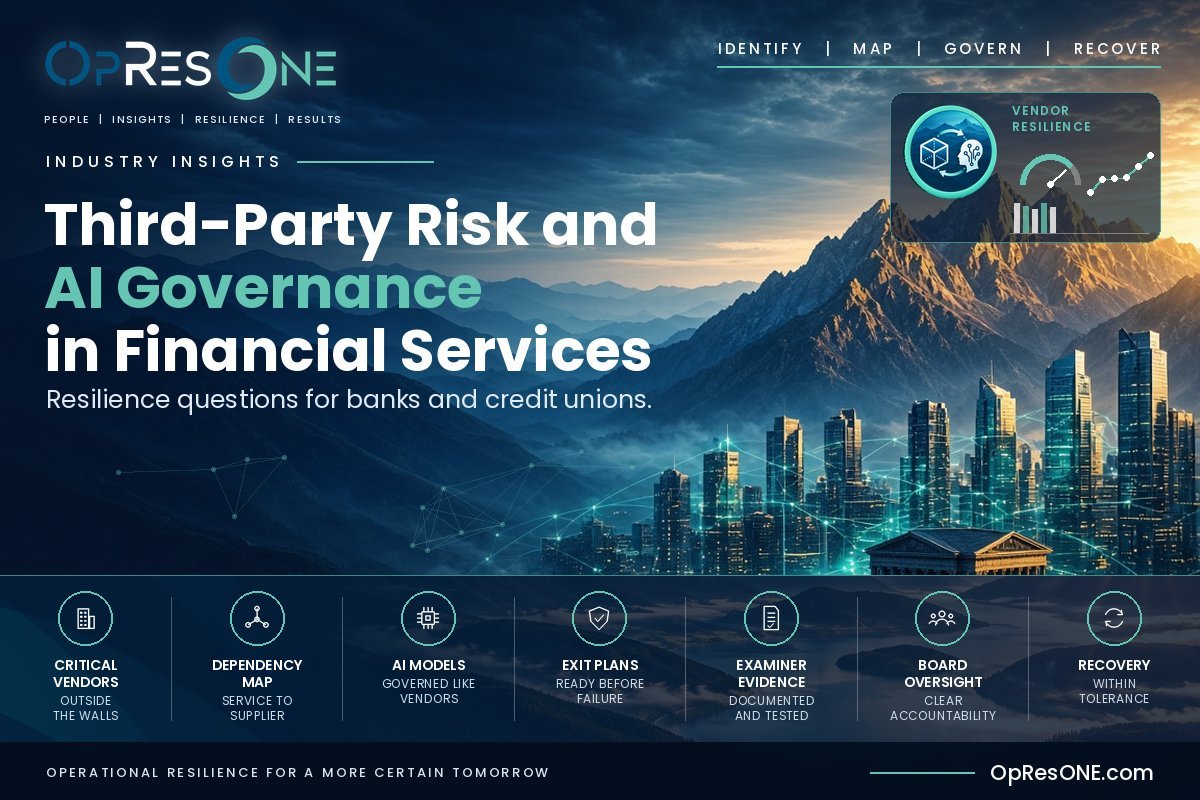
Banks and credit unions can keep a complete vendor file and still be unprepared for the afternoon a core processor, a cloud platform, or a model they do not fully control stops supporting a critical service. The useful question for a board is not whether due diligence checklists exist. It is whether the institution can keep important financial services available when those dependencies fail, and whether directors can see that picture in time to challenge it.
Two official developments make that question sharper. In June 2023, the Office of the Comptroller of the Currency, the Board of Governors of the Federal Reserve System, and the Federal Deposit Insurance Corporation issued the Interagency Guidance on Third-Party Relationships: Risk Management, which remains the current interagency view for the banking organizations those agencies supervise. On September 15, 2026, the same agencies, now joined by the National Credit Union Administration, published proposed replacement guidance and asked for comment by November 16, 2026. Until any final guidance is issued, the 2023 interagency guidance, and for credit unions the NCUA's existing third-party letter, are the documents institutions should work from.
At the same time, institutions are putting artificial intelligence into credit, fraud, operations, and customer service, often through vendors. A model that cannot be explained, tested, or replaced is not only an AI-governance issue. It is a third-party issue and an operational-resilience issue. This article looks at those three questions together, especially for community banks and credit unions.
Why this matters
A community bank or a complex credit union can depend on a handful of providers for its core system, payments, digital banking, card processing, and information security. Larger institutions have longer vendor lists, but they can be just as concentrated in a few shared platforms. In either case, the institution remains responsible for performing its activities in a safe and sound manner and in compliance with applicable law. The 2023 interagency guidance is explicit: using a third party does not diminish that responsibility, including obligations related to consumer protection and the security of customer information.
If a fraud model, a servicing platform, or a cloud region fails, the customer still looks to the institution. Examiners will look there as well. The FFIEC Business Continuity Management booklet already asks examiners to consider the institution's entire operations, including affiliates and third-party service providers. The booklet is examiner guidance, not a new regulation, but it is the frame many US institutions already use when they talk to their boards about resilience. A fuller briefing on what that booklet expects is in What the FFIEC Business Continuity Management Booklet Expects.
The current third-party standard, and what is only proposed
The 2023 Interagency Guidance on Third-Party Relationships: Risk Management is final as of June 6, 2023, and was published in the Federal Register on June 9, 2023 (88 FR 37920). It replaced each issuing agency's earlier general third-party guidance and is directed to all banking organizations those agencies supervise. It describes sound risk-management principles across the life cycle of a third-party relationship: planning, due diligence and third-party selection, contract negotiation, ongoing monitoring, and termination.
Sound practice is risk-based. It takes into account the level of risk, the complexity and size of the banking organization, and the nature of the particular relationship. Not every third-party relationship presents the same criticality. Relationships that support higher-risk or more critical activities warrant more comprehensive oversight. The guidance includes illustrative examples intended to help banking organizations, particularly community banks, align practice with the nature and risk of the relationship. Proportionate does not mean informal, and it does not mean undocumented.
Credit unions are not within the 2023 interagency guidance. For federally insured credit unions, the NCUA's current official letter is Evaluating Third Party Relationships (Letter 07-CU-13, December 2007), which transmitted supervisory guidance to field staff and to credit union boards. That letter stresses planning, due diligence, and controls commensurate with the credit union's risk profile and the type of relationship, including the critical nature of the service and ongoing oversight.
The September 2026 proposal is important, but it is not yet guidance. In the Federal Register notice (91 FR 58536, September 15, 2026), the OCC, Federal Reserve, FDIC, and NCUA invited comment on proposed third-party risk management guidance. The agencies said a final product would, if adopted, lead them to rescind and replace existing guidance to promote consistency and could, because the NCUA is a proposing agency, put credit unions under the same interagency document as banks. That is not the change in force today. Institutions should not pause work on the 2023 guidance or the NCUA letter while they wait.
Operational resilience when the critical service sits outside the institution
Operational resilience in financial services is the ability to keep important services available through disruption, not only to recover systems after the fact. For US institutions, the FFIEC Business Continuity Management booklet, issued in November 2019 as part of the IT Examination Handbook, is the examiner-facing statement of that shift. It asks for governance, a business impact analysis that captures interdependencies, exercises and tests that validate timely restoration of critical functions, and board reporting that supports a credible challenge. Third parties belong in each of those elements, not only in a contract appendix.
US groups with operations or entities in the European Union have a second, binding framework. Regulation (EU) 2022/2554, the Digital Operational Resilience Act, has applied since 17 January 2025. DORA sets harmonized rules on ICT risk management, incident reporting, operational resilience testing, and ICT third-party risk for a wide range of financial entities, and it creates an oversight framework for ICT third-party service providers designated as critical. A US institution with an in-scope EU entity, and a US technology provider that supports such an entity, may have obligations that a purely domestic vendor program will not automatically satisfy.
If a service is important to customers or to safety and soundness, the institution needs a current view of which third parties support that service, what happens if they cannot perform, and how quickly an alternative can be used. Concentration, including concentration in a provider that many institutions share, is part of that view. For a broader discussion of proving third-party resilience, shared dependencies, and what to do when a critical provider cannot recover, see Beyond Due Diligence: Proving Third-Party Resilience, The Hidden Risk of Concentration, and When a Critical Provider Cannot Recover.
AI governance is part of the same map
Many of the models now used in financial services are developed, hosted, or updated by third parties. That fact does not fit neatly into a traditional vendor file, or into a model inventory that never asks whether the model can be taken offline or replaced without interrupting a critical service.
There is, as of this writing, no single US banking rule that is an "AI act." There are official frameworks that boards and management can use now. The National Institute of Standards and Technology published the Artificial Intelligence Risk Management Framework (AI RMF 1.0), NIST AI 100-1, on January 26, 2023. It is voluntary, non-sector-specific, and organized around four functions: Govern, Map, Measure, and Manage. It describes characteristics of trustworthy AI, including that systems should be valid and reliable, safe, secure and resilient, accountable and transparent, explainable and interpretable, privacy-enhanced, and fair, with harmful bias managed. "Secure and resilient" is not a side topic in that list.
ISO/IEC 42001:2023, Information technology — Artificial intelligence — Management system, published in December 2023, is the first international management-system standard for AI. It specifies requirements for establishing, implementing, maintaining, and continually improving an AI management system in organizations that provide or use AI systems. Certification is voluntary and is not performed by ISO itself. The standard is useful as a way to put policies, roles, risk assessment, and lifecycle control in one system of management, including when the AI is supplied by a vendor.
Institutions that offer or deploy AI in the European Union also need to account for Regulation (EU) 2024/1689, the EU Artificial Intelligence Act. The Act entered into force on 1 August 2024 and applies in phases. Prohibited practices and certain other early obligations have applied since 2 February 2025, governance and general-purpose AI rules since 2 August 2025, and most remaining obligations since 2 August 2026. Some high-risk AI rules apply later. Whether a particular banking use is in scope is a legal and factual question. The resilience point is simpler: if a model supports a critical service, the institution should know its purpose, who can change it, how it is monitored, and what happens when it must be withdrawn.
Where the three issues meet
The meeting point is a service the institution cannot pause. A payments rail, a deposit platform, a lending path, or a fraud-decision service may depend on a vendor's availability and on a model's current behavior. If the vendor has a material incident, or if the model is withdrawn because it is no longer performing, the institution still has to serve members and customers within tolerances the board has accepted.
Planning should identify the activity, its criticality, and the third parties and models that support it. Due diligence should test whether the provider can meet resilience and governance expectations, not only financial and legal ones. Contracts should address performance, incident notification, audit and information rights, data return, and transition, including for model-based services. Ongoing monitoring should include exercises that involve the provider where the activity is critical, and should include monitoring of model performance, not only uptime. Termination planning should be written while the relationship is still healthy.
Community banks and credit unions will not staff this the way a large firm does. They can still produce a short, current inventory of critical third parties and AI uses, a documented rationale for the depth of oversight on each, evidence of monitoring, and a board report that a director can actually challenge. That is consistent with the 2023 guidance's emphasis on practices commensurate with risk, and with the NCUA letter's emphasis on due diligence that matches the critical nature of the service.
What organizations should do
Start with the services that would cause the greatest harm if they stopped, and map the third parties and AI systems that support them. Use the business impact analysis and the third-party inventory as one picture, not two. Include fourth parties where a critical provider depends on a subcontractor you cannot see.
Apply the current 2023 interagency life-cycle principles, or the NCUA letter if you are a credit union, to those relationships now. Treat the September 2026 proposal as a request for comment and a signal of supervisory direction, not as a reason to wait.
Put AI uses that support critical services through the same life cycle. Identify the intended purpose and the context of use. Know whether the institution, the vendor, or both can change the model. Decide in advance how you will monitor performance, how you will intervene, and how you would discontinue or replace the model if it is not performing. Use the NIST AI RMF and, where it is a useful management-system frame, ISO/IEC 42001, as structured ways to do that work. Do not claim conformity or certification you have not independently established.
Give the board a combined report: critical services, material third parties, material AI uses, test results, incidents, and open issues with owners and dates. Credible challenge is difficult if directors only see a vendor count and a list of AI pilots. See also From Plans to Proven Readiness and Operational Resilience: Where to Start.
How OpResONE can help
OpResONE helps financial institutions strengthen operational resilience, third-party oversight, and AI governance as a single management problem, including mapping critical services and preparing board reporting that supports informed challenge. Our work is independent. We have no affiliation with the OCC, the Federal Reserve, the FDIC, the NCUA, the FFIEC, NIST, or ISO, and this article is not an official interpretation of their documents.
We bring BRILLIANCE to RESILIENCE®.
Related resources
- What the FFIEC Business Continuity Management Booklet Expects
- Beyond Due Diligence: Proving Third-Party Resilience
- The Hidden Risk of Concentration
- When a Critical Provider Cannot Recover
- Connecting AI Governance and Resilience
- From AI Principles to Accountability
- From Plans to Proven Readiness
- Operational Resilience: Where to Start
Request a Strategy Call
If you want a focused reading of how your third-party and AI oversight lines up with the operational resilience of your critical financial services, talk with OpResONE about where to start.
Sources
- Interagency Guidance on Third-Party Relationships: Risk Management, final as of June 6, 2023, 88 FR 37920 (June 9, 2023)
- OCC Bulletin 2023-17, Third-Party Relationships: Interagency Guidance on Risk Management (June 6, 2023)
- FDIC FIL-29-2023, Interagency Guidance on Third-Party Relationships: Risk Management (June 6, 2023)
- Proposed Third-Party Risk Management Guidance, 91 FR 58536 (September 15, 2026); comments due November 16, 2026
- NCUA Letter 07-CU-13, Evaluating Third Party Relationships (December 2007)
- FFIEC IT Examination Handbook, Business Continuity Management booklet (InfoBase)
- Regulation (EU) 2022/2554 (Digital Operational Resilience Act), EUR-Lex
- NIST, Artificial Intelligence Risk Management Framework (AI RMF 1.0), NIST AI 100-1 (January 26, 2023)
- ISO/IEC 42001:2023, Information technology — Artificial intelligence — Management system
- Regulation (EU) 2024/1689 (EU Artificial Intelligence Act), EUR-Lex
- European Commission, AI Act overview


