- +1 (602) 922-5990
-
This email address is being protected from spambots. You need JavaScript enabled to view it. - Mon - Fri 8:00a - 5:00p AZ


-

Most organizations have a process for vetting suppliers. Before signing a contract, a provider completes a questionnaire, submits policies and certificates, and perhaps shares a summary of its business continuity plan. Procurement and risk teams review the responses, score the provider, and file the results. The relationship begins, and the file is revisited at renewal.
That process has value. It screens out providers with obvious weaknesses and creates a record of what was promised. But it rarely answers the question that matters most when a critical provider is disrupted: can this provider actually keep delivering, or recover quickly enough, to keep our critical services within acceptable limits? A questionnaire records what a provider says it can do. Resilience depends on what it can demonstrate.
This article explains how to move beyond paper-based due diligence toward evidence that critical providers can withstand and recover from disruption.
-
The FFIEC Business Continuity Management booklet is examiner guidance on how US financial institutions, and the service providers that support them, manage the availability of critical financial products and services. It is part of the FFIEC Information Technology Examination Handbook. When FFIEC member agencies published the booklet in November 2019, they replaced the Business Continuity Planning booklet issued in February 2015. The change from planning to management was intentional: expectations had moved toward the resilience of operations, not only a plan to recover after a disruption.
This article summarizes what the current booklet asks examiners to review on governance, the business impact analysis, exercises and tests, and board reporting. It is drawn from the FFIEC IT Examination Handbook InfoBase and does not describe a new edition. The booklet does not impose requirements on institutions; it describes practices examiners may use to assess a BCM function. OpResONE has no affiliation with the FFIEC, and this article is not an official interpretation of the booklet.
-
Banks and credit unions can keep a complete vendor file and still be unprepared for the afternoon a core processor, a cloud platform, or a model they do not fully control stops supporting a critical service. The useful question for a board is not whether due diligence checklists exist. It is whether the institution can keep important financial services available when those dependencies fail, and whether directors can see that picture in time to challenge it.
Two official developments make that question sharper. In June 2023, the Office of the Comptroller of the Currency, the Board of Governors of the Federal Reserve System, and the Federal Deposit Insurance Corporation issued the Interagency Guidance on Third-Party Relationships: Risk Management, which remains the current interagency view for the banking organizations those agencies supervise. On September 15, 2026, the same agencies, now joined by the National Credit Union Administration, published proposed replacement guidance and asked for comment by November 16, 2026. Until any final guidance is issued, the 2023 interagency guidance, and for credit unions the NCUA's existing third-party letter, are the documents institutions should work from.
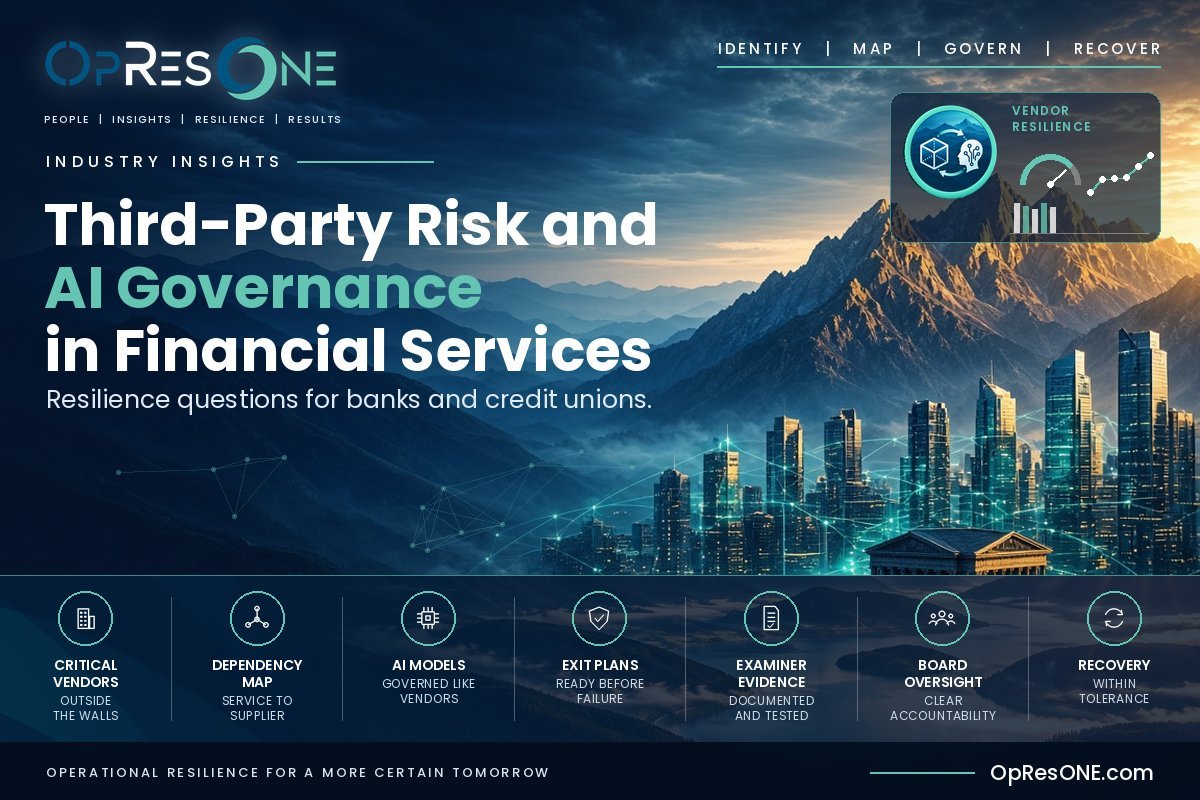
At the same time, institutions are putting artificial intelligence into credit, fraud, operations, and customer service, often through vendors. A model that cannot be explained, tested, or replaced is not only an AI-governance issue. It is a third-party issue and an operational-resilience issue. This article looks at those three questions together, especially for community banks and credit unions.