


On 16 November 2026, the UK House of Lords National Resilience Committee published its report, Are we ready? Building a culture of resilience (HL Paper 79). Its conclusion is blunt. In the Committee's words, the UK is "seriously underprepared" for the growing and interconnected risks it faces, and the Government must act urgently. Launching the report, the Committee's Chair, Baroness Coussins, said: "The world is more turbulent and insecure than it has been for decades."
The report is about national preparedness in the United Kingdom, but its central findings will be familiar to any operational resilience leader: plans that address single events rather than cascading ones, fragmented ownership, fragile supply chains, untested assumptions, and a private sector that is not fully part of the plan. This article summarizes what the Committee found and recommended, then offers OpResONE's perspective on what US and global organizations can take from it. The summary is drawn from the Committee's published report and press release; the commentary is ours. OpResONE is not affiliated with, and this article is not endorsed by, the UK Parliament.
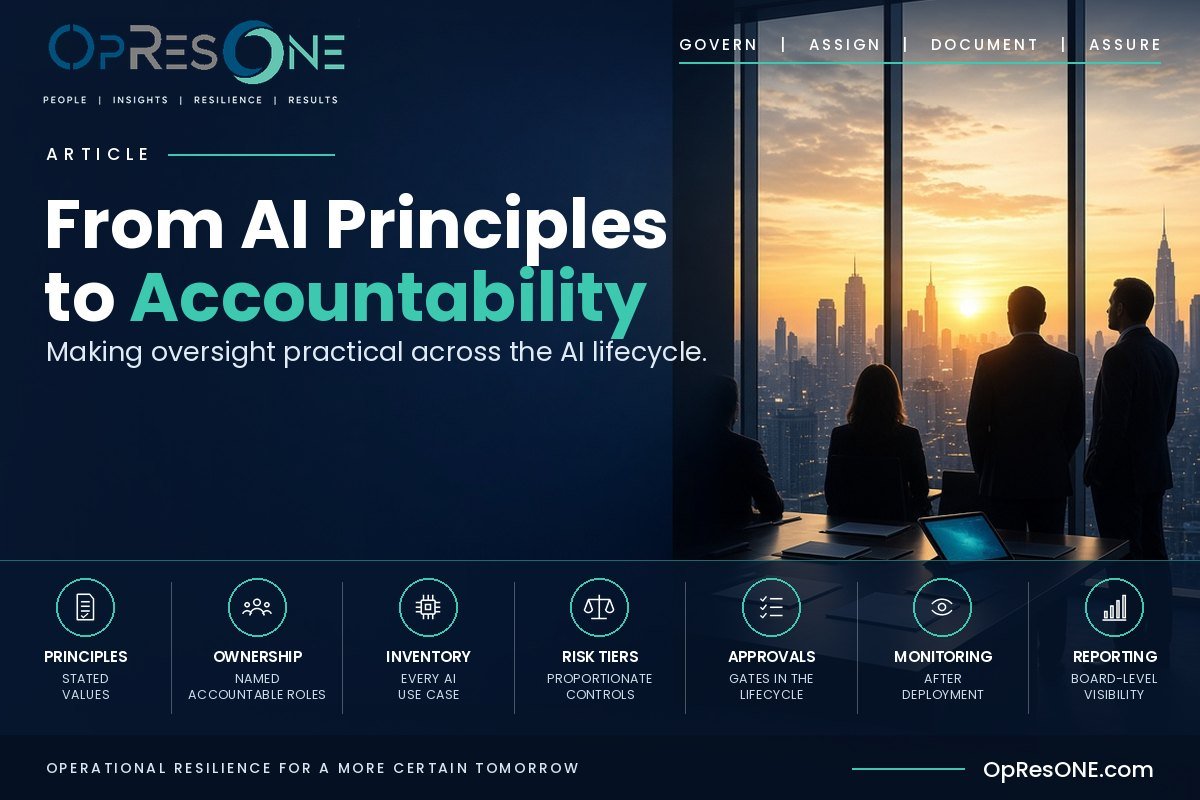
Over the past several years, many organizations have published statements of AI principles. They commit to fairness, transparency, privacy, safety, and human oversight. These statements are a reasonable starting point. They signal intent to employees, customers, and regulators, and they give teams a shared vocabulary.
But principles do not govern anything on their own. A commitment to fairness does not tell a product team which tests to run before launching a credit model. A commitment to transparency does not say who decides what customers are told when AI is involved in a decision. A commitment to human oversight does not specify who can stop a system that is behaving badly. Between the principle and the practice sits a gap, and that gap is filled either by deliberate accountability or by assumptions.
This article explains how to turn AI principles into practical accountability that works across the full lifecycle of AI systems, from the first idea to retirement.

Many organizations now run two important programs side by side without connecting them. One is AI governance: the policies, committees, and risk assessments that decide how artificial intelligence may be developed, bought, and used. The other is operational resilience: the discipline of keeping critical services running through disruption. They are often staffed by different people, report to different executives, and use different vocabularies.
That separation made sense when AI sat at the edges of the business, in pilots and productivity tools. It makes less sense now that AI models help route customer calls, flag fraud, schedule maintenance, draft communications, and prioritize work queues. When AI becomes part of how a critical service is delivered, its failure becomes a resilience problem, and resilience planning that ignores it has a blind spot.
This article explains why the two disciplines need each other and how leaders can connect them without building another layer of bureaucracy.


