


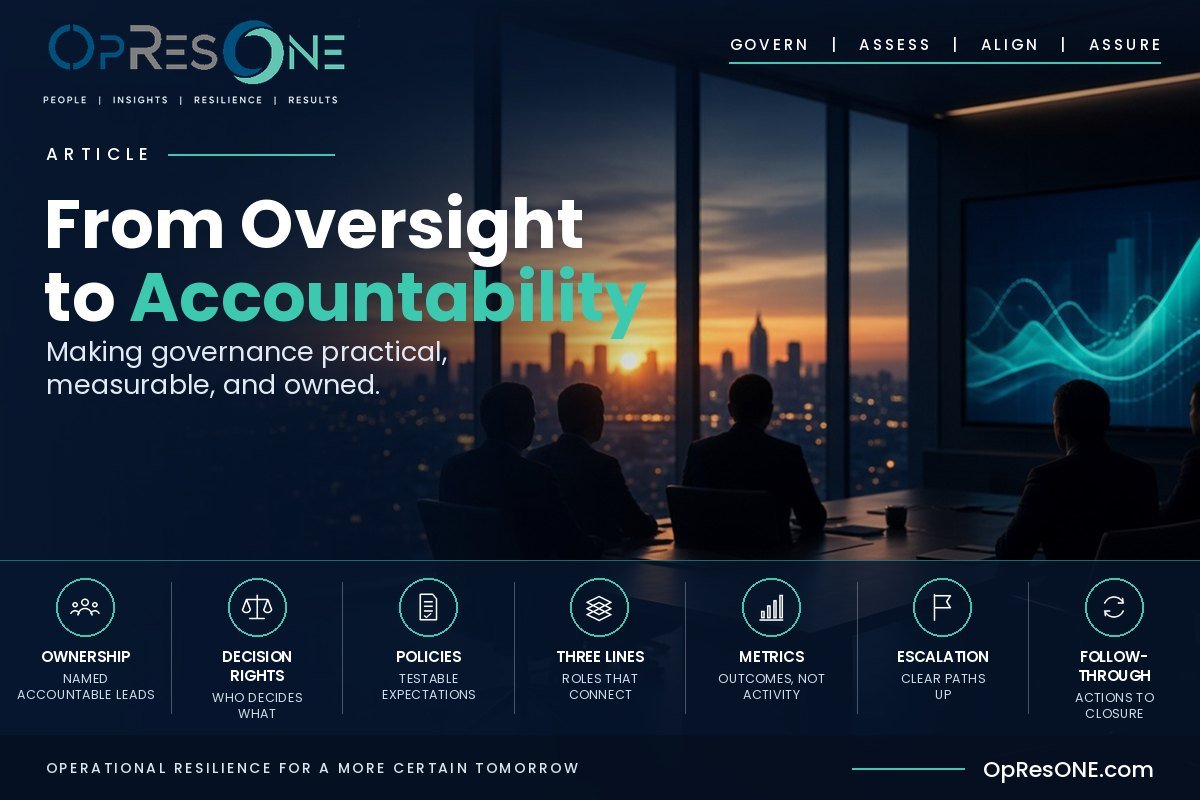
Most boards and executive teams would say their organization has governance. There is a charter, a committee calendar, a risk register, a set of policies, and a steady flow of reports. Yet when a serious disruption, a regulatory inquiry, or a failed control lands on the table, the same question tends to surface: who actually owned this decision, and how did we know it was working? Oversight that cannot answer that question is activity, not governance.
This article explains how to turn governance from a set of structures into a practical system of accountability, one where decisions have named owners, expectations are written down, and leaders can see evidence that the organization is doing what it says it does. It is written for directors, executives, and the GRC leaders who support them.
Why this matters
Governance is the mechanism that connects what an organization intends with what it actually does. When it works, leaders set direction, delegate clearly, and receive honest information about progress and risk. When it does not, accountability blurs across committees and functions, and problems surface late, often after they have become expensive.
Several pressures are making this gap harder to ignore. Boards are expected to show informed oversight of risks that used to sit deep in operations, including cybersecurity, technology resilience, and third-party dependencies. In the United States, for example, the SEC's 2023 cybersecurity disclosure rules require public companies to describe how the board oversees cybersecurity risk and how management assesses and manages it. Financial-services regulators, standard setters, and investors increasingly ask not only whether a framework exists, but whether it works and who is responsible for it.
International guidance points the same way. ISO 37000:2021, the international guidance on the governance of organizations, treats accountability, oversight, and the use of data in decisions as core governance principles rather than administrative details. The IIA's Three Lines Model (2020) makes a similar point from the assurance side: the governing body is accountable for oversight, management owns the actions that achieve objectives and manage risk, and internal audit provides independent assurance. None of these frameworks is satisfied by a committee that meets but does not decide, or a policy that exists but is not owned.
The business challenge
In practice, governance tends to break down in predictable places.
- Ownership is assumed rather than assigned. A risk sits with "IT" or "operations" instead of a named executive. When something goes wrong, several people were involved and no one was accountable.
- Committees multiply, decisions do not. Overlapping risk, audit, technology, and compliance committees review the same material from different angles. Each adds meetings; few add clarity about who decides what.
- Reporting describes activity, not outcomes. Dashboards count policies reviewed, trainings completed, and findings closed. They rarely tell leaders whether critical services are protected or whether risk is within the levels the board has accepted.
- Policies are disconnected from operations. A policy sets an expectation, but no process, control, or metric shows whether people follow it. The policy library grows while practice drifts.
- Escalation paths are unclear. Frontline teams do not know when a problem must go up, and senior leaders learn about issues through audit findings or incidents rather than through management reporting.
The result is a governance model that looks complete on paper and feels heavy to the people inside it, yet still leaves leaders exposed when they are asked to explain a decision or demonstrate control.
Key concept: accountability is designed, not declared
Practical governance rests on a simple idea: accountability has to be designed into how the organization works. That design has four parts.
1. Decision rights
Every significant category of decision needs a clear owner and a clear forum. Which decisions are reserved for the board? Which are delegated to the CEO and executive team? Which sit with a risk owner or a service owner? A short decision-rights matrix often does more for accountability than a long governance manual, because it answers the question people actually ask: "Is this mine to decide?"
2. Expectations that can be checked
Accountability requires a standard to be accountable against. That means policies and objectives written so that someone could tell whether they are being met. "We maintain strong information security" cannot be checked. "Critical systems are restored within agreed recovery times and tested at least annually" can. Measurable expectations turn governance from opinion into evidence.
3. Evidence flows
Leaders cannot oversee what they cannot see. Governance needs a defined flow of information from the people who do the work, through those who monitor and challenge it, to the executives and directors who are accountable for it. The Three Lines Model is useful here, not as a rigid org chart but as a reminder that management reporting, second-line monitoring, and independent assurance each play a distinct role. When those flows are designed together, the board receives a coherent picture rather than three competing ones.
4. Consequences and follow-through
Accountability means something only if gaps lead to action. That includes tracking remediation to closure, revisiting ownership when it is not working, and recognizing teams that surface problems early. A culture that punishes bad news will soon stop receiving it.
An illustration
Consider a common decision: onboarding a new technology provider that will support a customer-facing service. In a governance model built on oversight alone, procurement runs its process, security completes a questionnaire, legal negotiates terms, and the contract is signed. Each function did its part, yet no one was asked whether the dependency fits the organization's risk appetite or how the service would continue if the provider failed.
In an accountable model, the decision-rights matrix names the service owner as the person who decides, with security, legal, procurement, and risk as required consultees. The third-party policy sets a testable expectation, such as an exit or substitution plan for providers that support critical services. The evidence flow means the decision, the assessment, and any accepted exceptions are recorded where second-line teams and auditors can see them. If the provider later causes a disruption, leaders can trace who decided, on what basis, and what was done. That traceability is what accountability looks like in practice.
What "measurable" looks like
Measurable governance does not require a large set of metrics. It requires a few well-chosen measures tied to the expectations leaders care about most. Useful categories include:
- Coverage: Do all critical services, key risks, and material obligations have named owners?
- Currency: Are policies, risk assessments, and plans reviewed on the cycle the organization set for itself?
- Effectiveness: Do tests, exercises, and control checks show that key safeguards work as intended?
- Timeliness: Are issues escalated and remediated within agreed timeframes?
- Alignment: Is the organization's actual risk position within the appetite and tolerances the board approved?
Each measure should have an owner, a definition, a data source, and a threshold that triggers attention. Without those four elements, a metric is a number on a slide rather than a governance tool.
What organizations should do
Making governance practical is less about adding structure and more about clarifying the structure that already exists. A focused program might follow these steps.
- Map the current governance landscape. List the committees, charters, policies, and reports in place today. Note where mandates overlap, where decisions are actually made, and where the same information is reviewed several times.
- Define decision rights for the decisions that matter most. Start with a small number of high-consequence areas, such as risk appetite, critical service priorities, major technology change, third-party onboarding, and incident escalation. Record who recommends, who decides, who must be consulted, and who must be informed.
- Assign named owners. Give every critical service, top risk, and key policy an accountable executive, not a department. Confirm that each owner understands and accepts the role.
- Rewrite expectations so they can be tested. Review key policies and objectives and turn broad statements into specific commitments, with an indication of how compliance or performance will be shown.
- Design the reporting chain. Agree what management reports, what second-line functions monitor and challenge, what internal audit independently assures, and how each reaches the executive team and board. Remove duplicate reporting where possible.
- Select a small set of governance measures. Use the coverage, currency, effectiveness, timeliness, and alignment categories above. Pilot them for two or three reporting cycles before expanding.
- Build follow-through into the calendar. Track actions from committee meetings, audit findings, and exercises to closure. Review overdue items at the executive level, and revisit ownership when actions stall.
- Review and simplify annually. Governance should get lighter as it matures. Each year, ask which committees, reports, and policies still earn their place.
Organizations that already use a GRC platform can often support these steps with existing tools, for example by linking owners, policies, risks, controls, and evidence in one place. The tool helps, but the design decisions come first. Automating an unclear governance model only makes the confusion faster.
Leadership considerations
Directors and executives shape whether governance becomes practical or remains procedural. Several questions are worth asking directly.
- Can each executive name the risks and services they personally own? If the answer requires checking a spreadsheet, ownership is not yet real.
- What decisions did this committee actually make last quarter? A committee that mostly receives information may be better replaced by a report.
- Does our reporting tell us whether we are within appetite, or only what activity occurred? Ask for outcome measures alongside activity counts.
- How do we learn about problems: through management, or through audit and incidents? The answer reveals how well the evidence flow works.
- Where are first, second, and third line roles blurred? Some blending is practical, especially in smaller organizations, but it should be a deliberate choice with compensating oversight.
- Is bad news welcome? Leaders set the tone. Visible appreciation for early escalation does more for accountability than any charter.
Leaders should also be realistic about pace. Moving from oversight to accountability is a change in habits, not a single project. Start with the areas of highest consequence, show progress through better decisions and clearer reporting, and extend the approach over time.
How OpResONE can help
OpResONE works with boards, executive teams, and GRC leaders to make governance practical, measurable, and proportionate to the organization's size and risk profile. Our GRC Management advisory work typically includes:
- GRC strategy and governance: defining oversight, accountability, and decision rights, and building a practical GRC roadmap.
- Enterprise risk management: connecting risk ownership and risk appetite to the decisions leaders make every day.
- Compliance and controls: mapping obligations to controls and organizing the evidence that shows they work.
- GRC process and platform alignment: connecting workflows, data, and technology around how the business actually operates. As an Authorized SwissGRC Channel Partner for the United States and Canada, we can help organizations that use or are evaluating the SwissGRC GRC Toolbox align it with their governance design.
- Assurance and board reporting: turning risk and control information into decision-ready reporting for executives and directors.
For teams building internal capability, OpResONE is an authorized PECB training partner and offers training courses that prepare professionals for PECB credentials, including the ISO 37000 Lead Corporate Governance Manager and ISO 31000 Risk Manager programs. PECB awards the credentials.
Related resources
- GRC Management advisory services
- Connecting Risk to Business Decisions
- Beyond the Compliance Checklist
- From Compliance to Confidence
- GRC Maturity and Readiness Checklist (featured resource)
Schedule a strategy call
If your governance model produces more meetings than decisions, or your board reporting describes activity rather than outcomes, a focused conversation is a good place to start. Schedule a strategy call with OpResONE to discuss your priorities and practical next steps toward accountable, measurable governance.
Sources
- ISO 37000:2021, Governance of organizations — Guidance
- The IIA, "The IIA's Three Lines Model: An Update of the Three Lines of Defense" (2020)
- SEC, "SEC Adopts Rules on Cybersecurity Risk Management, Strategy, Governance, and Incident Disclosure by Public Companies" (press release 2023-139, July 26, 2023)


