- +1 (602) 922-5990
-
This email address is being protected from spambots. You need JavaScript enabled to view it. - Mon - Fri 8:00a - 5:00p AZ


-

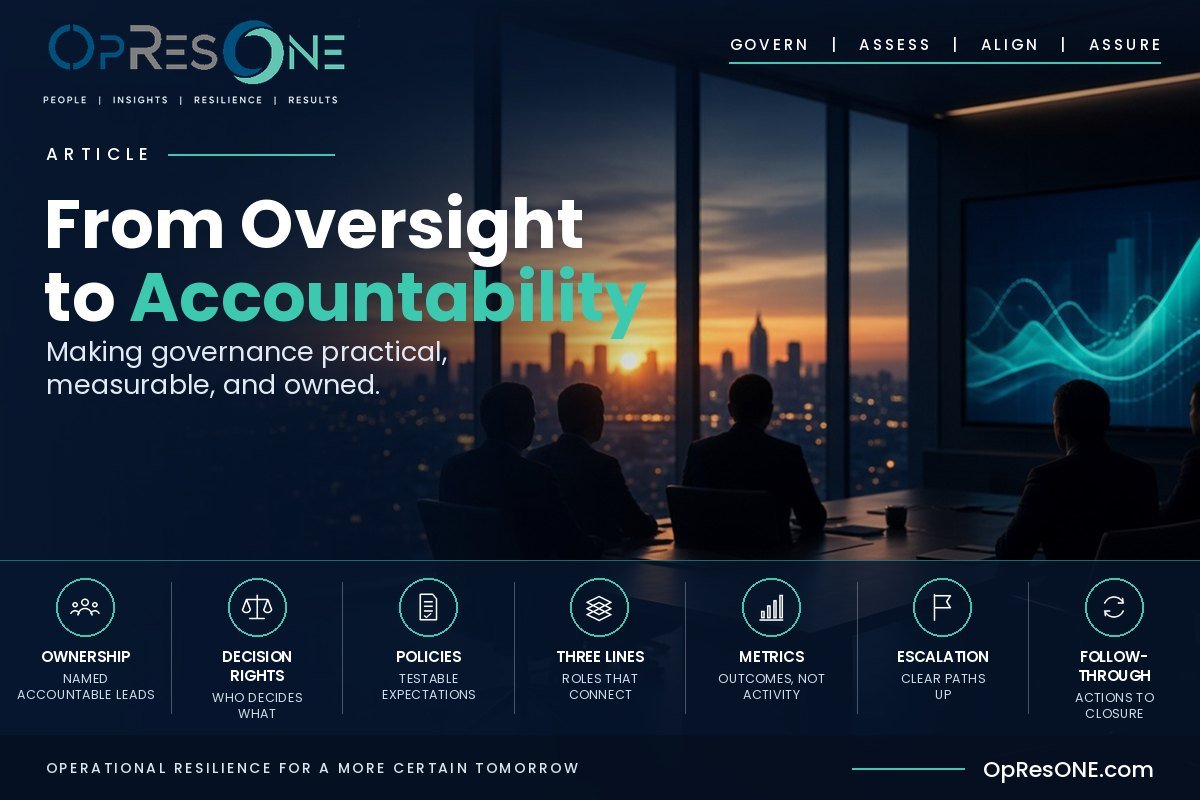
Most boards and executive teams would say their organization has governance. There is a charter, a committee calendar, a risk register, a set of policies, and a steady flow of reports. Yet when a serious disruption, a regulatory inquiry, or a failed control lands on the table, the same question tends to surface: who actually owned this decision, and how did we know it was working? Oversight that cannot answer that question is activity, not governance.
This article explains how to turn governance from a set of structures into a practical system of accountability, one where decisions have named owners, expectations are written down, and leaders can see evidence that the organization is doing what it says it does. It is written for directors, executives, and the GRC leaders who support them.
-
Many disaster recovery tests end with a report that says "passed." Every task on the test plan was completed: servers were failed over, databases were restored, applications started, and the checklist was signed. Yet a closer look often reveals that the test measured whether steps were carried out, not whether the business could operate again within the time and data loss it can tolerate. A recovery plan can be executed flawlessly and still leave the organization unready.
This article explains how to move from recovery plans that are documented and periodically exercised to tested readiness: a state in which the organization has current evidence that critical services can be recovered to agreed outcomes, and a program that keeps that evidence current. It is written for IT disaster recovery professionals, CIOs, and the continuity and risk leaders who oversee recovery capability.
-
Ask most organizations whether they are prepared for a serious disruption and the answer will usually point to documents: a business continuity plan, a disaster recovery runbook, a crisis communications playbook, an incident response policy. Those documents matter. They capture decisions, assign roles, and set out procedures. But a plan describes what an organization intends to do. It does not show what the organization can actually do under pressure.
The distance between those two things is the readiness gap. It is where well-written plans meet stale contact lists, untested recovery steps, suppliers that cannot meet their contractual commitments, and leaders who have never made decisions together under time pressure. Closing that gap, and being able to demonstrate that you have closed it, is what separates documented resilience from proven readiness.
This article sets out a practical way for executives and boards to move from plans to evidence, and from activity reporting to outcome measurement.
-
Every resilience professional has seen it: an exercise surfaces a serious weakness, the debrief is lively, a report is written, and a year later the next exercise surfaces the same weakness. The contact list is still out of date. The escalation path is still unclear. The manual workaround still depends on one person who knows how it works. The lesson was identified, but it was never learned.
Exercises and real incidents are only as valuable as the changes they produce. Turning findings into lasting improvement requires a disciplined process: understanding why something went wrong, assigning clear ownership, defining what "fixed" means, and then proving the fix through retesting. Without that discipline, an exercise program becomes an expensive way to rediscover known problems.
This article sets out a practical approach to closing the loop, from the moment an exercise ends to the point where the organization can show that it is measurably more ready.
-
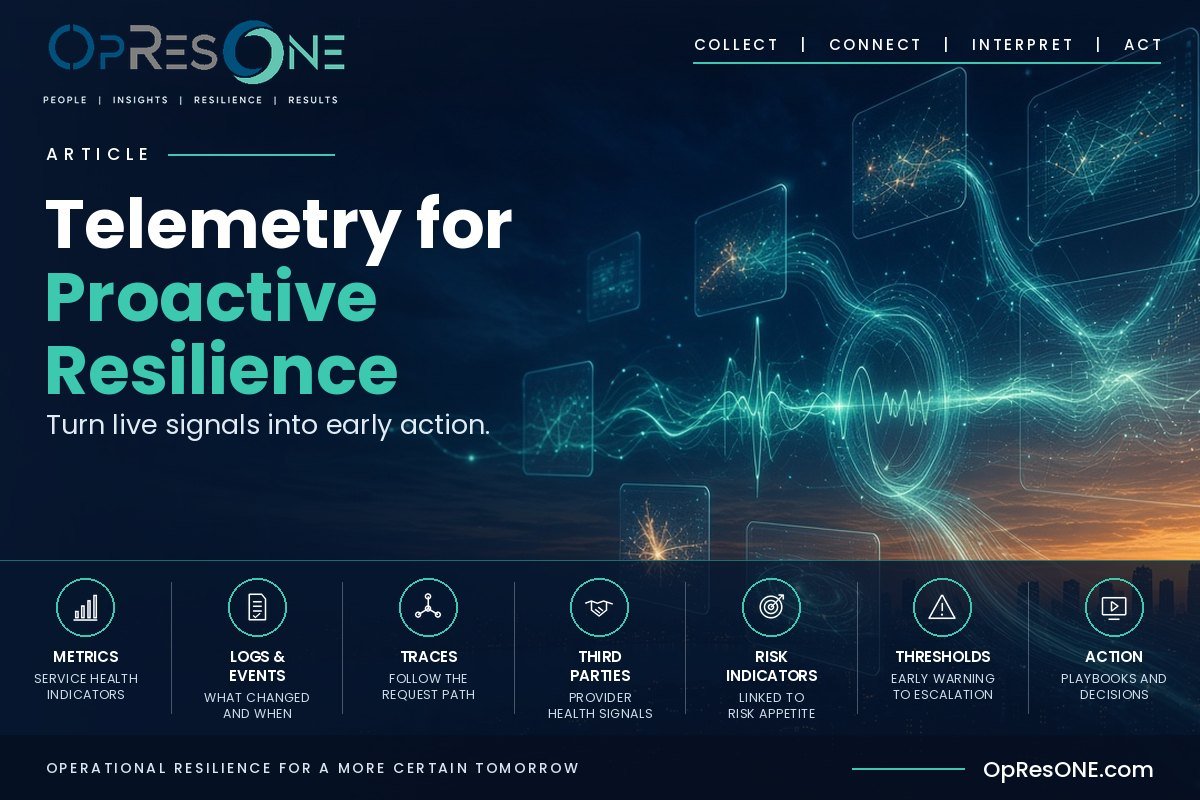
Most organizations already collect more operational data than they use. Applications write logs, infrastructure reports metrics, security tools raise alerts, cloud and SaaS providers publish service status, and business systems record every transaction. Yet when a disruption arrives, leaders often learn about it from a customer complaint, a social media post, or a call from a frustrated business unit. The signals were there. They were simply not connected to the services that matter, not interpreted in time, or not routed to someone with the authority to act.
Telemetry for proactive resilience means ingesting and analyzing real-time and near-real-time data across your environment to detect changes, identify emerging risks, and take preventive action before disruption escalates. This article explains what operational telemetry is, how to connect it to important business services and impact tolerances, and how to turn live signals into early insight that supports better decisions. It is written for operational resilience leaders, CIOs, and the risk and technology teams who support them.