


When ransomware strikes, the first question many executives ask is, "Do we have backups?" It is a reasonable question, but it is not the most important one. The harder questions are whether those backups are intact, whether they are free of the attacker's tools, which point in time can be trusted, what must be rebuilt before anything can be restored, and how the organization will know a restored system is safe to reconnect.
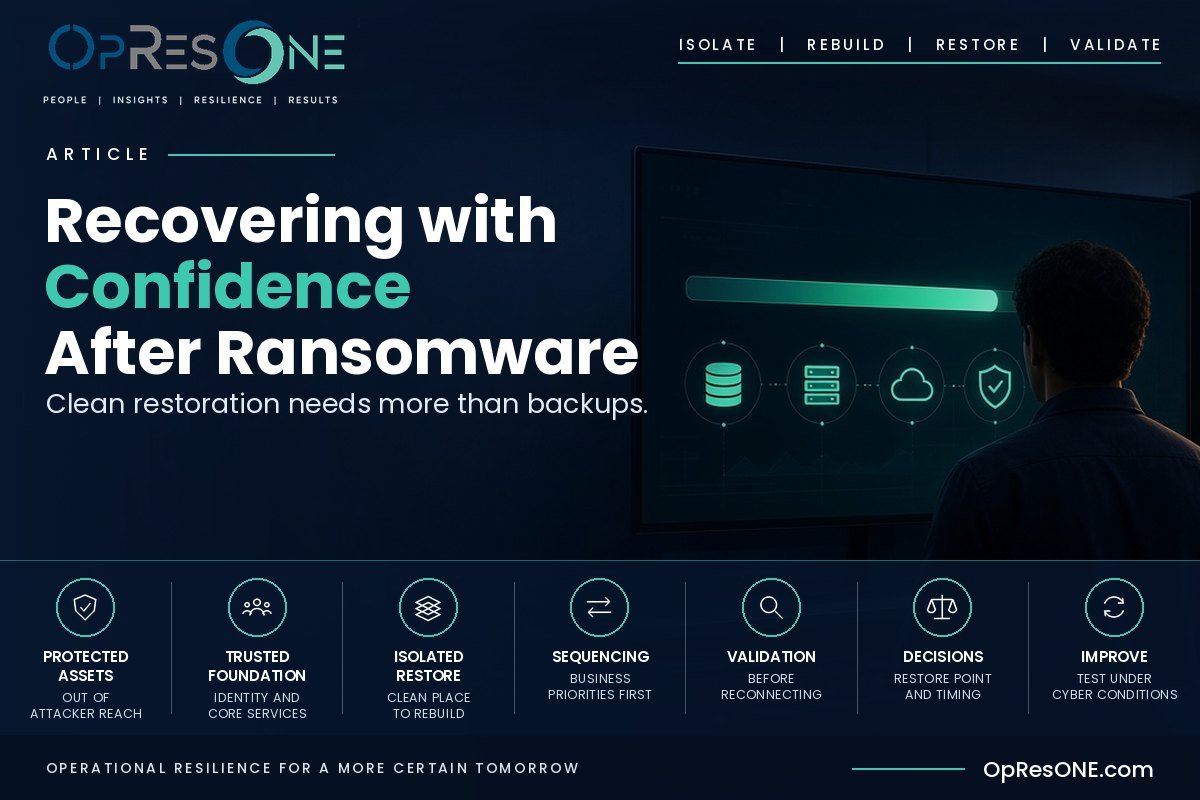
Clean restoration needs more than backups. It requires a recovery capability designed for an adversary who may have been inside the environment for some time, may have targeted backup systems deliberately, and may try to return. This article explains what that capability involves and how organizations can prepare for it. It is written for CIOs, CISOs, and the infrastructure and recovery leaders who would carry out the work.
Why this matters
Ransomware is designed to make recovery hard. The joint #StopRansomware Guide published by CISA, the FBI, NSA, and MS-ISAC notes that many ransomware variants attempt to find and delete or encrypt accessible backups, which is why it recommends maintaining offline, encrypted backups and regularly testing their availability and integrity in a disaster recovery scenario. The guide also warns that attackers often leave additional malware behind, and that care is needed to identify it before rebuilding from backups to prevent continuing compromise.
These points change what recovery means. In a hardware failure or site outage, the goal is to restore the most recent copy as quickly as possible. In a ransomware event, the most recent copy may be the least trustworthy. Restoring too quickly can reintroduce the attacker. Restoring too cautiously can extend an outage beyond what customers, regulators, and the business can tolerate. Getting the balance right requires preparation that most traditional disaster recovery plans do not include.
The business challenge
Organizations that discover gaps in their ransomware recovery capability usually find them in the same places.
- Backups are reachable from the production environment. If administrative credentials or management consoles are compromised, an attacker can delete, encrypt, or corrupt backups before triggering the attack.
- No one knows which restore point is clean. Without good logging and forensic support, teams cannot easily determine when the compromise began, and therefore which backup predates it.
- Recovery depends on systems that are themselves compromised. Identity services, management tools, DNS, and virtualization platforms are often needed to restore everything else. If they are untrusted, the recovery plan cannot start.
- There is nowhere safe to restore. Restoring into the same network that was compromised risks reinfection. Many organizations have no isolated environment ready to receive and validate restored systems.
- Recovery order is unclear. Teams restore what is familiar or what is loudest rather than what the business needs first.
- Validation is informal. Systems are declared recovered when they start, without checks for persistence mechanisms, integrity of data, or confirmation from business users that the service works correctly.
Key concept: clean restoration as a designed capability
Clean restoration is the ability to bring critical services back using systems and data that the organization has confirmed to be trustworthy, in an environment that will not reintroduce the threat, in an order that reflects business priorities. It rests on five building blocks.
1. Protected recovery assets
Recovery assets include backups of data, but also system images, configurations, infrastructure-as-code templates, software installation media, license information, and recovery documentation. CISA's guidance recommends maintaining "golden images" of critical systems, keeping infrastructure-as-code templates backed up offline, and storing network and asset documentation securely with offline copies. The common principle is separation: recovery assets should be protected so that an attacker who controls production cannot reach or alter them. That typically means offline or logically isolated copies, immutability where available, and separate administrative credentials.
2. A trusted foundation
Before business applications can be restored, the services they depend on must be rebuilt or validated. These usually include identity and access management, privileged access, core network services, and the platforms that host workloads. Recovery plans should identify this foundation explicitly and describe how it would be re-established in a trusted state, including the break-glass access needed when normal administrative accounts cannot be trusted.
3. An isolated recovery environment
An isolated environment, separated from the compromised network, allows teams to restore systems, inspect them, and validate them before they are reconnected. It can be a dedicated set of infrastructure, a segregated cloud tenancy, or a pre-planned segment of the existing environment, provided it can be trusted and controlled. CISA's guidance makes the related point that if a new network segment is created for recovery, only clean systems should be added to it.
4. Business-driven sequencing
Not everything can be restored at once. Recovery order should be set in advance by the business, based on the critical services identified in business continuity and operational resilience planning, their impact tolerances, and their dependencies. A recovery sequence that starts with the trusted foundation and then moves through the most critical services gives teams a clear path under pressure.
5. Validation before reconnection
Each restored system should pass defined checks before it rejoins the production environment. Technical checks look for indicators of compromise, unauthorized accounts, persistence mechanisms, and configuration drift. Data checks confirm integrity and identify any gap between the restore point and the time of the attack. Business checks confirm that the service works as expected. The organization should also decide in advance who can approve reconnection and on what evidence.
Decision points during recovery
Clean restoration involves a series of decisions that executives should be prepared to make or delegate:
- When to isolate or shut down systems, accepting immediate disruption to limit spread.
- Which restore point to use, balancing data loss against the risk of reinfection.
- Whether to restore or rebuild specific systems.
- How long to operate in degraded or manual mode while validation is completed.
- When a service can be returned to customers.
Each of these decisions benefits from pre-agreed criteria and named decision-makers. Under pressure, an organization that has already agreed how to decide will move faster and more safely than one that must negotiate authority during the incident.
Common misconceptions
Several assumptions can create false confidence about ransomware recovery.
- "Our backups are immutable, so we are covered." Immutability protects backup copies from being altered or deleted, which is valuable. It does not by itself tell the organization which copy is clean, provide a safe place to restore it, or rebuild the identity and infrastructure services that restoration depends on.
- "Our cloud provider handles this." Cloud and software-as-a-service providers typically operate under shared responsibility models. Organizations should confirm exactly what their providers back up, how long copies are retained, how restoration is requested, and whether configurations and data they manage themselves are included.
- "Recovery ends the incident." CISA's guidance describes how attackers increasingly exfiltrate data and threaten to release it, a tactic known as double extortion. Restoring systems does not resolve that exposure. Legal, privacy, regulatory, and communications work may continue long after services are back.
- "We will figure out priorities when it happens." Recovery teams under pressure need a sequence they can follow. Without one, the order of restoration is set by whoever escalates loudest.
Recognizing these misconceptions early helps leaders ask better questions of their teams and providers.
What organizations should do
Preparing for clean restoration can be organized into a practical sequence.
- Identify critical services and their recovery order. Confirm with business leaders which services must come back first and the tolerances that apply.
- Inventory recovery assets. List the backups, images, configurations, templates, documentation, and software needed to rebuild each critical service and its foundation.
- Protect recovery assets from production. Implement offline or logically isolated copies, immutability where appropriate, and separate credentials and management paths for backup systems.
- Document the trusted foundation. Describe how identity, privileged access, core network services, and hosting platforms would be rebuilt or validated, including break-glass procedures.
- Establish an isolated recovery environment. Decide where restored systems will be validated, and confirm that it can be stood up within the timeframes critical services require.
- Define validation criteria. Agree on technical, data, and business checks for each critical service, and who approves reconnection.
- Arrange forensic support in advance. Make sure internal teams or retained partners can help determine the scope and timeline of a compromise quickly, so that clean restore points can be identified.
- Test restoration under cyber conditions. Go beyond confirming that backups complete. Restore critical services into the isolated environment, run validation checks, and measure how long each step takes against tolerances.
- Rehearse the decisions. Use executive tabletop exercises to practice the isolation, restore-point, and reconnection decisions described above.
- Improve continuously. Feed findings from tests, exercises, and real incidents into the recovery design, and report progress to leadership.
Leadership considerations
Ransomware recovery is a business decision as much as a technical one. Executives should be ready to discuss:
- Do we know which services we would restore first, and has the business agreed? Priorities set during an incident tend to reflect whoever is most urgent, not what matters most.
- Could an attacker with administrative access reach our backups? If the answer is uncertain, protecting recovery assets is a priority.
- When did we last restore a critical service end to end, in conditions that resemble a cyberattack? Backup job reports are not proof of recoverability.
- Who decides when a restored service is safe to return to customers? That authority should be clear before an incident.
- How long can we operate in degraded mode? Business continuity arrangements buy time for careful validation. Without them, pressure to restore quickly may outweigh caution.
- Are our key technology providers prepared to support a clean recovery? Managed service providers, cloud platforms, and software vendors may hold parts of the recovery capability. CISA's guidance advises ensuring that third parties responsible for backups follow the same practices.
How OpResONE can help
OpResONE helps organizations prepare to recover from ransomware with confidence, connecting technical recovery with business priorities. Our Cyber Resilience advisory work can include:
- Reviewing recovery assets, backup protection, and recovery assumptions against ransomware scenarios.
- Defining business-driven recovery sequencing for critical services, linked to impact tolerances and dependencies.
- Helping design isolated recovery and validation approaches, including criteria for reconnection.
- Integrating cyber recovery with incident response, business continuity, and crisis management plans.
- Designing exercises and recovery validation that test both technical restoration and executive decisions.
For teams building skills in this area, OpResONE is an authorized PECB training partner and offers training courses that prepare candidates for PECB credentials, including ISO 27035 Lead Incident Manager and disaster recovery management credentials. PECB awards the credentials.
Related resources
- Cyber Resilience advisory services
- Beyond Prevention: Building Cyber Resilience
- Beyond the Backup: Proving Recoverability
- IT Disaster Recovery advisory services
- Cyber Resilience Readiness Checklist (featured resource)
Schedule a strategy call
If your ransomware plan begins and ends with "restore from backup," it may be time to look more closely. Schedule a strategy call with OpResONE to discuss your recovery assets, your critical services, and practical steps toward clean, confident restoration.
Sources
- CISA, MS-ISAC, NSA, and FBI, #StopRansomware Guide (updated October 2023)
- NIST SP 800-61 Rev. 3, Incident Response Recommendations and Considerations for Cybersecurity Risk Management: A CSF 2.0 Community Profile (April 2025)
- NIST, The NIST Cybersecurity Framework (CSF) 2.0, CSWP 29 (February 26, 2024)


