


Most organizations can list hundreds of systems. Far fewer can name, on one short page, the handful of services their customers cannot do without. That short list is what "important business services" means in practice.
The term comes from UK financial regulation. The Financial Conduct Authority (FCA) and the Prudential Regulation Authority (PRA) require in-scope firms to identify their important business services and set an impact tolerance for each one. You do not need to be a UK bank to use the idea.
 What an important business service is
Put simply, it is a service you provide to someone outside your organization that would cause real harm if it stopped. The PRA describes important business services as delivering "a specific outcome or service to an identifiable user," and distinguishes them from business lines, which are collections of services. A mortgage business is a business line. Letting a customer make a mortgage payment is a service.
The FCA frames the test around harm: firms should identify the services that, if disrupted, could cause intolerable harm to consumers or markets. Its own examples are everyday ones, such as customers being unable to access their accounts or pay bills.
The distinction sounds academic until you try to act on it. A business line is too broad to own or test as a single thing, a system is too narrow to tell you why it matters, and an internal service such as payroll matters only because of what it enables. The table below shows how the same organization can describe one activity in four different ways, and which of them belongs on the short list.
| Item | Example | How to treat it |
|---|---|---|
| Business line | Mortgages | A collection of services. Break it down until each item has a clear user and outcome. |
| Important business service | Letting a customer make a mortgage payment | Put it on the short list, give it an owner and an impact tolerance. |
| Internal service | Payroll | Not an important business service on its own. Capture it when you map what customer-facing services depend on. |
| System or supplier | A payments platform or a hosting provider | A resource you map behind the services it supports. |
 Why the list starts with customers, not systems
It is tempting to begin with the technology inventory. That approach tends to produce a long list of systems, each labeled critical, and little help deciding what to protect first.
Starting with the customer changes the question. Instead of asking which systems matter, you ask which outcomes would hurt the people you serve if they stopped. The PRA says firms should not identify internal services alone, such as payroll, as important business services. The FCA makes the same point, and adds that those internal processes should be captured when firms map the people, processes, technology, facilities and information that support the customer-facing services.
Systems still matter. They simply come second, as the things you map once you know which services they support. Putting them second also makes conversations with technology teams easier, because a recovery priority can be explained by the customer outcome it protects rather than argued system by system.
 Why the idea travels beyond UK banking
The idea is not unique to UK regulation. The Basel Committee on Banking Supervision's Principles for Operational Resilience (March 2021) define operational resilience as "the ability of a bank to deliver critical operations through disruption," and ask banks to assume that disruptions will occur. Writing about banks in October 2025, McKinsey's Risk and Resilience Practice names impact-driven management of nonfinancial risk as one of four actions leading institutions are taking. Whatever the label, the common thread is the same: start from the outcome that has to keep working, not from the catalogue of controls.
Outside financial services, the argument is as much about accountability as about regulation. In a May 2026 Harvard Business Review article, Abhilash Panda and his co-authors observe that the greatest damage from a disruption often comes from how failures spread through connected systems, and that most organizations have no single executive accountable for coordinating resilience and recovery when failures cascade across functions. A short list of important business services, each with a named owner, is one practical answer to that gap.
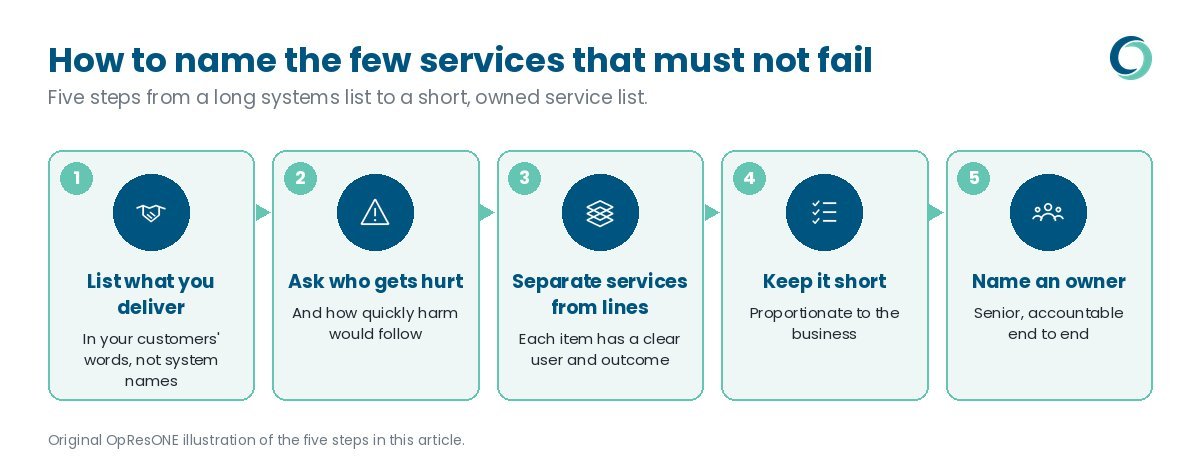
 How to name the few that must not fail
- List what you deliver, in your customers' words. "Pay a supplier." "Receive a claim payment." "Place an order." Avoid system names and department names.
- Ask who gets hurt, and how quickly. For each service, consider the harm to customers, to the market or community you serve, and to the organization itself if the service were unavailable.
- Separate services from business lines. If an item is really a portfolio of services, break it down until each item has a clear user and a clear outcome.
- Keep the list short enough to act on. The PRA expects the number of important business services to be proportionate to the business. A list that names everything prioritizes nothing.
- Name an owner for each service. Someone senior should be accountable for the service end to end, not only for the systems underneath it.
A list that names everything prioritizes nothing. The short list is where resilience work starts.OpResONE perspective
 What comes next
Once the list exists, three steps follow. Map what each service depends on: people, processes, technology, facilities, information and the suppliers behind them. Decide how much disruption each service can tolerate before the harm becomes unacceptable; UK regulators call this an impact tolerance. Then test whether you can actually stay within it.
Suppliers deserve particular attention in that mapping. In a December 2023 press release, Gartner reported that 45% of organizations it surveyed had experienced third party-related business interruptions during the previous two years. The survey covered 376 senior executives, and the finding is a reminder that the weakest link in an important business service often sits outside the organization.
Testing is where the list proves its worth. The PRA notes in SS1/21 that impact tolerances assume a disruption has already occurred, so testing should focus on response and recovery rather than on preventing the incident. That framing only works if everyone agrees which services are being tested, which is why the short list comes first and the scenario library comes second.
 Key takeaway
Write each important business service as an outcome for an identifiable user, keep the list proportionate to the business, and give every service a senior owner and a review date at least once a year.
The list also needs to stay current. The PRA expects firms to review their important business services at least annually, or sooner if a significant change occurs. Treat the list as something with an owner and a review cycle, not the output of a single workshop. For organizations that have finished a one-time service map but have no one named to keep it current, OpResONE's Operational Resilience as a Service offering is built for that ongoing work.
 Questions for your leadership team
- Can we name our important business services on one page, in our customers' words?
- Does each one have a senior owner who is accountable end to end?
- When did we last review the list, and what has changed in the business since then?
 How OpResONE can help
OpResONE helps leadership teams identify their important business services, map their dependencies, and put an ownership and review cycle in place. For organizations that have finished a one-time service map but have no one named to keep it current, our Operational Resilience as a Service offering is built for that ongoing work. Our work is aligned with recognized frameworks and regulatory expectations.
OpResONE has no affiliation with the FCA, the PRA, the Basel Committee, Gartner, Harvard Business Review or McKinsey, and this article is not an official interpretation of any rule.
Explore OpResONE:
- Advisory and Consulting
- Technology Platforms
- Certifications and Training
- Solutions: Managed Services
We bring BRILLIANCE to RESILIENCE®.
Related resources
- Operational Resilience: Where to Start
- Mapping Dependencies Before Disruption: Recovering Applications in the Right Order
- Are We Ready? What the UK National Resilience Report Means for Organizations
- Beyond Due Diligence: Proving Third-Party Resilience
Request a Strategy Call
If you want a second view on which of your services belong on the short list, and who should own them, talk with OpResONE about where to start.
 Sources and further reading
- Financial Conduct Authority, Operational resilience (firms page) (last updated September 15, 2026).
- Financial Conduct Authority, PS21/3 Building operational resilience, Chapter 2 (March 2021).
- Prudential Regulation Authority, Supervisory Statement SS1/21 Operational resilience: Impact tolerances for important business services (web page) (March 2021, updated March 2022).
- Prudential Regulation Authority (Bank of England), SS1/21 Operational resilience: Impact tolerances for important business services (March 2022 version) (March 2022). Chapter 2 and paragraph 3.1.
- Basel Committee on Banking Supervision, Principles for Operational Resilience (March 2021).
- McKinsey & Company, Operational resilience has become critical. How are banks responding? (October 21, 2025).
- Harvard Business Review, The Case for Hiring a Chief Resilience Officer, by Abhilash Panda and co-authors (May 21, 2026). Public summary and opening paragraph only.
- Gartner, Gartner Survey Finds 45% of Organizations Experienced Third Party-Related Business Interruptions During the Past Two Years (press release) (December 13, 2023).
Summaries are in OpResONE's own words. Short quotations are attributed to their source. Figures and tables are original OpResONE illustrations; no third-party charts or logos are reproduced. OpResONE has no affiliation with, and is not endorsed by, the organizations cited.


