- +1 (602) 922-5990
-
This email address is being protected from spambots. You need JavaScript enabled to view it. - Mon - Fri 8:00a - 5:00p AZ


-

The organizations that lead in 2027 will not be those that avoid disruption. They will be those designed to absorb disruption, protect critical outcomes, recover intelligently, and adapt faster than the conditions around them change.
-
 Artificial intelligence is moving rapidly from experimentation into the operating fabric of the enterprise. AI systems are influencing customer interactions, cybersecurity decisions, financial analysis, fraud detection, supply chains, software development, workforce productivity, risk management, and increasingly, decisions that once depended entirely on human judgment.
For executives, that creates extraordinary opportunity. It also creates a difficult new question.
-
Business continuity is entering a fundamentally different era. For decades, organizations approached continuity primarily as a planning discipline: conduct a business impact analysis, identify recovery requirements, document procedures, test the plans periodically, and update them each year. Those practices remain important, but they are no longer sufficient for the environment executives face in 2027.
-
Organizations have traditionally viewed disruption as something they must prevent, withstand, and recover from. Business continuity teams prepare plans. Technology teams build recovery capabilities. Cybersecurity teams establish defenses. Risk teams monitor exposure. Executives establish crisis structures designed to protect the organization when something goes wrong.
-
When a crisis ends, the instinct is to move on. Teams are exhausted, normal work has piled up, and leaders want to put the disruption behind them. Yet the period after a crisis is one of the most valuable an organization will have. It is the moment when weaknesses are most visible, when people are most willing to change, and when leaders have the clearest view of what truly matters to customers, employees, and the business.
Organizations that use this moment well come out stronger. They fix what failed, reinforce what worked, and make decisions that leave them better prepared for whatever comes next. This article explains how to turn disruption into lasting improvement through disciplined lessons learned. It is written for executives and the operational resilience, continuity, and crisis leaders who guide recovery.
-
Every resilience professional has seen it: an exercise surfaces a serious weakness, the debrief is lively, a report is written, and a year later the next exercise surfaces the same weakness. The contact list is still out of date. The escalation path is still unclear. The manual workaround still depends on one person who knows how it works. The lesson was identified, but it was never learned.
Exercises and real incidents are only as valuable as the changes they produce. Turning findings into lasting improvement requires a disciplined process: understanding why something went wrong, assigning clear ownership, defining what "fixed" means, and then proving the fix through retesting. Without that discipline, an exercise program becomes an expensive way to rediscover known problems.
This article sets out a practical approach to closing the loop, from the moment an exercise ends to the point where the organization can show that it is measurably more ready.
-
Most leaders do not need to be persuaded that disruption is coming. They have lived through cloud outages, ransomware attacks on suppliers, staffing shocks, and severe weather that closed sites without warning. The harder question is practical: where do you begin when "operational resilience" seems to touch every function, every system, and every contract at once?
The answer is to start narrow and deliberate. Operational resilience is the ability to keep delivering the services that matter most when something goes wrong, and to stay within limits the organization has decided it can accept. That definition gives you a starting point. You do not begin with every risk, every asset, or every plan. You begin with a short list of services, the harm that would follow if they stopped, and the people accountable for them. Everything else builds from there.
This article sets out a practical sequence for the first twelve months, written for executives and the resilience leaders who support them.
-
An operational resilience program depends on more than a policy and a set of documents. It depends on people who can identify important business services, set impact tolerances, map the resources those services need, and test the organization's ability to stay within those tolerances when something goes wrong. If only a small team understands those tasks, the program will stall the first time a service owner, a technology lead or a senior manager has to make a decision the documents do not already answer.
This article explains the skills an operational resilience program needs, and how operational resilience training supports that work. It uses the language of important business services, impact tolerances, mapping and scenario testing as it appears in the United Kingdom's operational resilience framework, and it notes how similar ideas show up in other regimes without treating those regimes as identical. OpResONE has no affiliation with the Financial Conduct Authority (FCA), the Prudential Regulation Authority (PRA) or the Federal Financial Institutions Examination Council (FFIEC). This article is not an official interpretation of their publications.
-
The tabletop exercise is the workhorse of continuity and crisis programs, and for good reason. It is inexpensive, it brings the right people into one room, and it can surface gaps in roles, communication, and decision-making without disrupting operations. But many tabletop exercises share a quiet flaw: they are built to walk through the plan rather than to test it. The scenario unfolds the way the plan expects, participants describe what they would do, the facilitator nods, and everyone leaves reassured.
Reassurance is not the goal. The purpose of an exercise is to find out what is not true before a real event does. That requires deliberate design: clear objectives, explicit assumptions to challenge, scenarios that create genuine pressure, and an evaluation method that captures evidence rather than impressions.
This article sets out how to design exercises that go beyond the tabletop, whether you keep the discussion-based format or move toward more operational testing.
-
Many organizations can produce a list of courses people have attended. Fewer can show that the people who run business continuity, operational resilience or AI governance can actually do the work those systems require. Attendance is not competence. Management system standards treat that distinction as a requirement, not as a training preference.
This article explains why competency development matters, what ISO 22301:2019 and ISO/IEC 42001:2023 require in clause 7.2, how a simple competency framework helps, and how to move beyond attendance certificates to demonstrated competence. It paraphrases the published requirements; audit interpretations should be made against a licensed copy of each standard. OpResONE has no affiliation with ISO, and this article is not an official interpretation of the standards.
-
FOR IMMEDIATE RELEASE
The company will join business continuity and operational resilience practitioners at DRJ's Fall 2027 Conference, September 12-15, 2027, at the Sheraton San Diego Resort on Harbor Island in San Diego, California.

A 2015 aerial photograph of the Sheraton San Diego Resort on Harbor Island in San Diego, California, the venue for DRJ's Fall 2027 Conference, September 12-15, 2027. "Aerial - looking across North San Diego Bay to Coronado 02." Photo: Joe Mabel, CC BY 3.0 (https://creativecommons.org/licenses/by/3.0), via Wikimedia Commons, modified. AVONDALE, Ariz. — OpResONE, Inc., the US Partner for Battleground Group, announced that it will be a Bronze sponsor and exhibitor at DRJ's Fall 2027 Conference, September 12-15, 2027, at the Sheraton San Diego Resort on Harbor Island in San Diego, California.
"DRJ's Fall Conference is where continuity and resilience practitioners compare what actually works when a disruption hits," said Joseph Brewer, CEO and Principal Consultant at OpResONE. "We are proud to support DRJ's Fall 2027 Conference in San Diego as a Bronze sponsor and exhibitor, and I hope colleagues will come talk with us about practical ways to keep critical operations running."
DRJ's Fall 2027 Conference brings together the people accountable for business continuity and operational resilience. Those practitioners share a practical problem: how to keep critical services available through disruption, how to test whether plans will hold, and how to show leadership that the work is real. A conference setting gives them a chance to learn from peers and take useful ideas back to their organizations.

Branded OpResONE graphic: Meet OpResONE in the Exhibit Hall. OpResONE works with organizations through Advisory Services, Certifications & Training, and its Software Technology Platform. Advisory Services help teams design and improve business continuity and operational resilience programs. As a PECB Authorized Training Partner, OpResONE offers professional training, and PECB issues the credentials. The Software Technology Platform supports the systems that help those programs operate. OpResONE also offers Business Continuity as a Service, Operational Resilience as a Service, and GRC as a Service.
OpResONE invites business continuity and operational resilience practitioners who plan to attend DRJ's Fall 2027 Conference to connect with the team. Leaders who would like to continue the conversation, or who are not attending, may Request a Strategy Call.
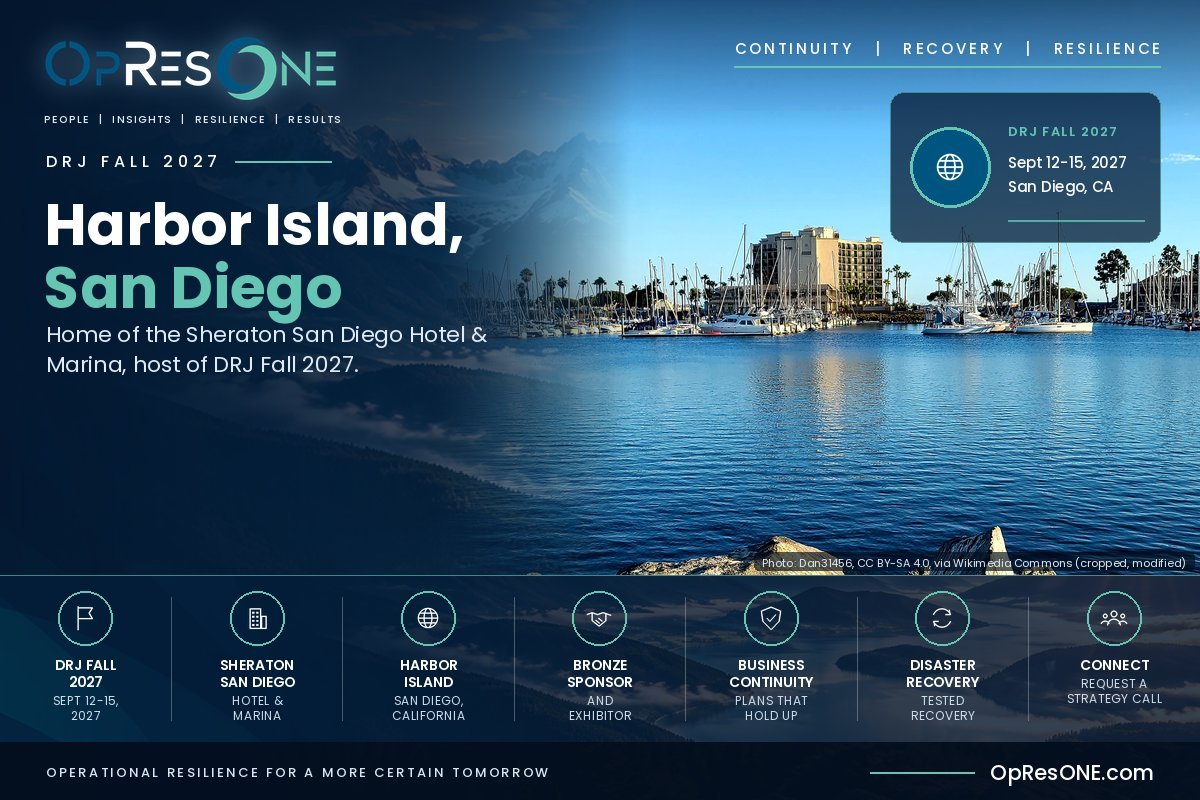
Harbor Island in San Diego, California, photographed from Spanish Landing in 2021, with the Sheraton San Diego Resort across the marina, the venue for DRJ's Fall 2027 Conference, September 12-15, 2027. "View of Harbor Island from Spanish Landing." Photo: Dan31456, CC BY-SA 4.0 (https://creativecommons.org/licenses/by-sa/4.0), via Wikimedia Commons, modified. About OpResONE
OpResONE, Inc., the US Partner for Battleground Group, provides Advisory Services, Certifications & Training, and a Software Technology Platform that help organizations strengthen operational resilience, business continuity, and governance, risk, and compliance. OpResONE is an Authorized SwissGRC Channel Partner for the United States and Canada and a PECB Authorized Training Partner. PECB issues the credentials associated with that training. The company maintains its office at 12725 W Indian School Road, Suite E-101, Avondale, AZ 85392-9520. Visit https://opresone.com. We bring BRILLIANCE to RESILIENCE®
Media Contact
Joseph Brewer
CEO and Principal Consultant
OpResONE, Inc.This email address is being protected from spambots. You need JavaScript enabled to view it.
602.922.5990###