- +1 (602) 922-5990
-
This email address is being protected from spambots. You need JavaScript enabled to view it. - Mon - Fri 8:00a - 5:00p AZ


-

Most leaders do not need to be persuaded that disruption is coming. They have lived through cloud outages, ransomware attacks on suppliers, staffing shocks, and severe weather that closed sites without warning. The harder question is practical: where do you begin when "operational resilience" seems to touch every function, every system, and every contract at once?
The answer is to start narrow and deliberate. Operational resilience is the ability to keep delivering the services that matter most when something goes wrong, and to stay within limits the organization has decided it can accept. That definition gives you a starting point. You do not begin with every risk, every asset, or every plan. You begin with a short list of services, the harm that would follow if they stopped, and the people accountable for them. Everything else builds from there.
This article sets out a practical sequence for the first twelve months, written for executives and the resilience leaders who support them.
-
Most organizations already collect more operational data than they use. Applications write logs, infrastructure reports metrics, security tools raise alerts, cloud and SaaS providers publish service status, and business systems record every transaction. Yet when a disruption arrives, leaders often learn about it from a customer complaint, a social media post, or a call from a frustrated business unit. The signals were there. They were simply not connected to the services that matter, not interpreted in time, or not routed to someone with the authority to act.
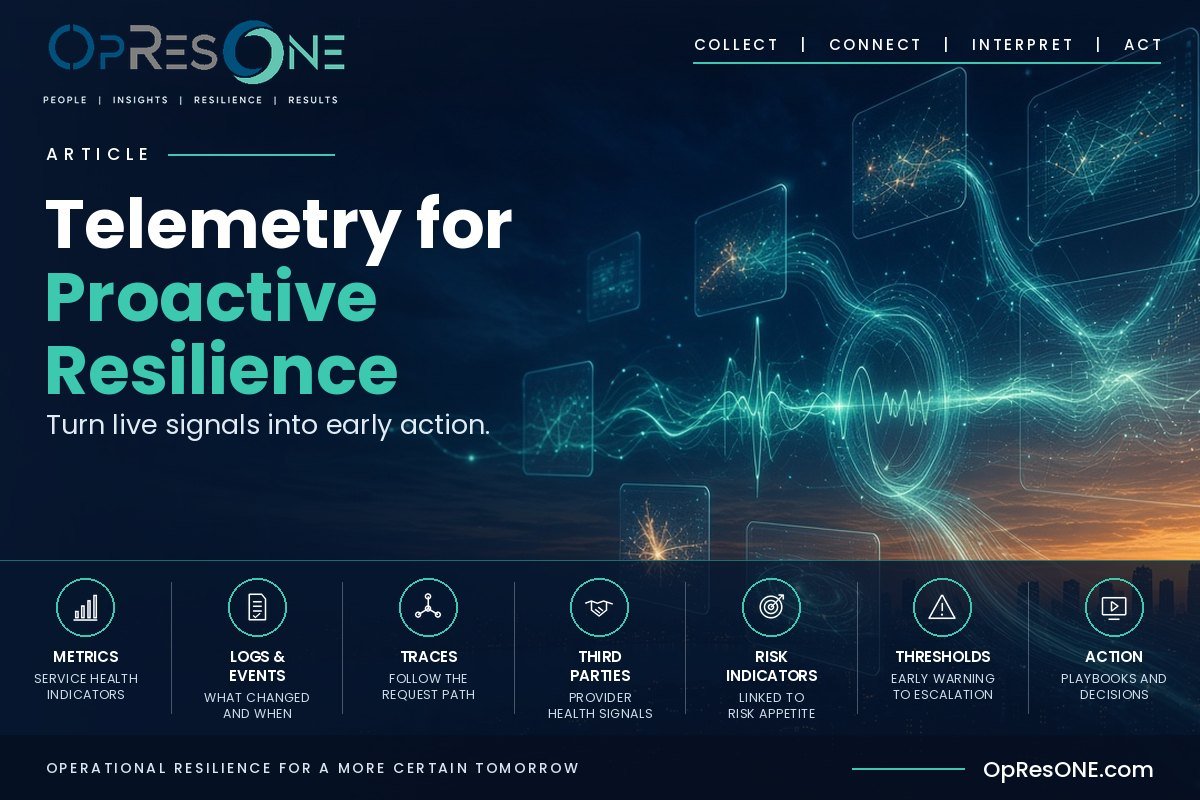
Telemetry for proactive resilience means ingesting and analyzing real-time and near-real-time data across your environment to detect changes, identify emerging risks, and take preventive action before disruption escalates. This article explains what operational telemetry is, how to connect it to important business services and impact tolerances, and how to turn live signals into early insight that supports better decisions. It is written for operational resilience leaders, CIOs, and the risk and technology teams who support them.
-
An operational resilience program depends on more than a policy and a set of documents. It depends on people who can identify important business services, set impact tolerances, map the resources those services need, and test the organization's ability to stay within those tolerances when something goes wrong. If only a small team understands those tasks, the program will stall the first time a service owner, a technology lead or a senior manager has to make a decision the documents do not already answer.
This article explains the skills an operational resilience program needs, and how operational resilience training supports that work. It uses the language of important business services, impact tolerances, mapping and scenario testing as it appears in the United Kingdom's operational resilience framework, and it notes how similar ideas show up in other regimes without treating those regimes as identical. OpResONE has no affiliation with the Financial Conduct Authority (FCA), the Prudential Regulation Authority (PRA) or the Federal Financial Institutions Examination Council (FFIEC). This article is not an official interpretation of their publications.