




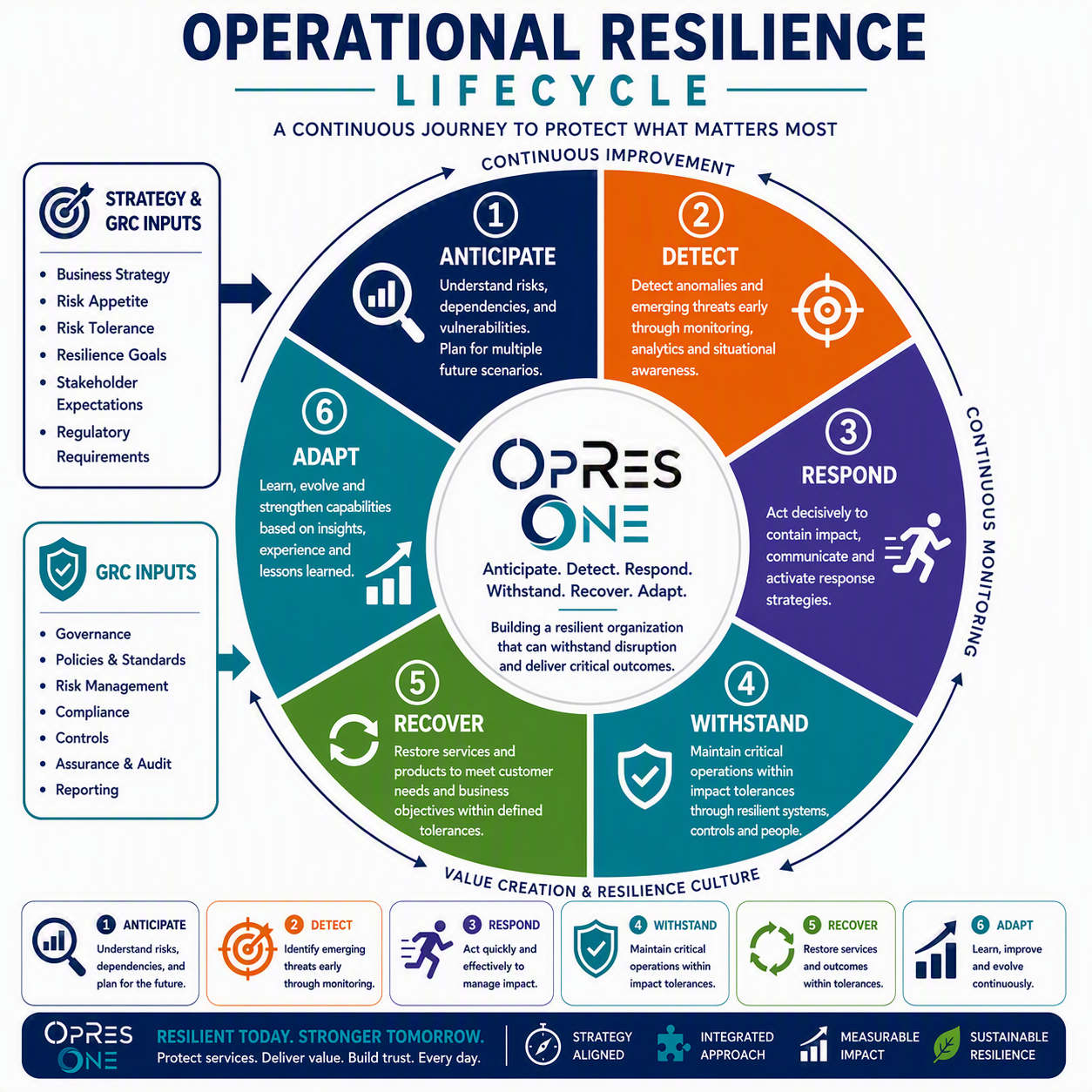
Operational resilience is never finished.
Every incident, exercise, audit, near miss, supplier issue, cyber event, technology outage, and operational challenge creates new intelligence. The question is whether the organization uses that intelligence to improve.
The Adapt phase turns experience into action. It ensures resilience remains aligned with business strategy, technology modernization, regulatory expectations, customer needs, and emerging threats.
Organizations that adapt become stronger over time. Organizations that do not adapt repeat the same failures.
The Adapt phase asks:
What did we learn, what must change, and how do we make the organization more resilient going forward?
Key Inputs
The Adapt phase relies on evidence from across the resilience lifecycle, including:
- Incident reports
- Post-incident reviews
- Lessons learned results
- Exercise findings
- Audit findings
- Control testing results
- Maturity assessments
- Performance metrics
- Impact tolerance breaches
- Recovery validation results
- Supplier performance reviews
- Cyber event analysis
- Regulatory feedback
- Customer complaints
- Risk assessments
- Executive governance decisions
- Program benchmarking results
These inputs allow the organization to identify recurring weaknesses, improvement opportunities, investment needs, and governance gaps.
Lifecycle Process
The Adapt phase creates a structured process for continuous improvement.
Core adaptation activities include:
-
Capture lessons learned
Gather insights from incidents, exercises, failed controls, near misses, audits, and operational events. -
Analyze root causes
Determine whether issues were caused by process failure, technology weakness, supplier dependency, control gaps, unclear roles, poor escalation, insufficient training, or governance failure. -
Prioritize improvements
Rank corrective actions based on risk reduction, critical service impact, regulatory importance, cost, complexity, and strategic value. -
Update resilience capabilities
Revise plans, controls, operating models, playbooks, supplier requirements, continuity strategies, monitoring indicators, and governance reporting. -
Measure progress
Track remediation, resilience maturity, control effectiveness, test performance, incident trends, and impact tolerance alignment. -
Report to leadership
Provide executive-level visibility into resilience posture, improvement progress, persistent risk, investment needs, and strategic roadmap priorities. -
Feed lessons back into the lifecycle
Ensure improvements inform the next Anticipate, Detect, Respond, Withstand, and Recover cycles.
Key Outputs
The Adapt phase should create outputs that support measurable improvement, including:
- Lessons learned report
- Root cause analysis
- Corrective action plan
- Continuous improvement roadmap
- Updated resilience maturity assessment
- Control optimization plan
- Updated business continuity plans
- Updated disaster recovery plans
- Updated incident response playbooks
- Updated supplier resilience requirements
- Updated KRIs, KPIs, and KCIs
- Governance review report
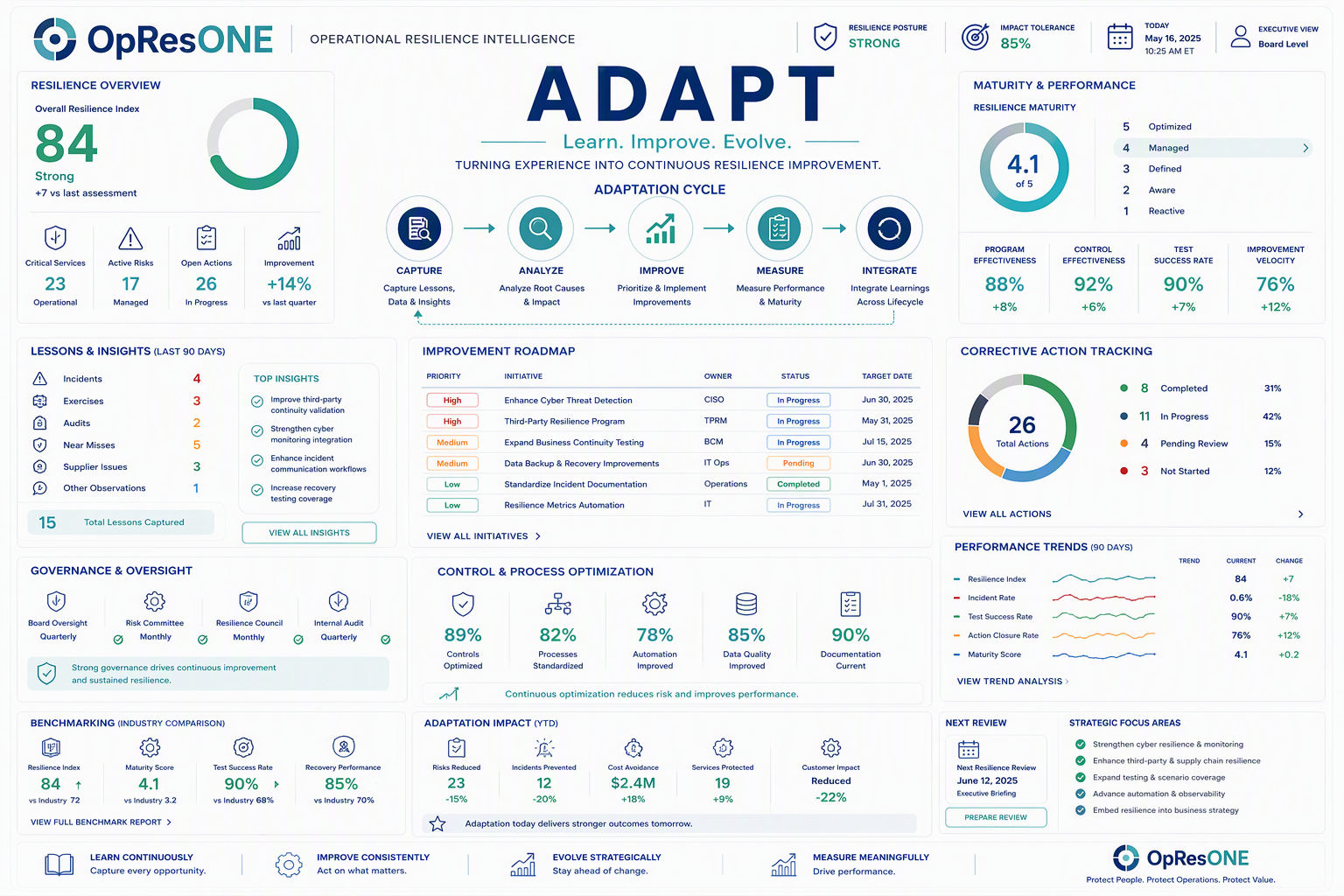
- Executive resilience performance dashboard
- Strategic resilience roadmap
- Board-level resilience briefing
Why This Phase Matters
Without adaptation, resilience programs become stale. Plans become outdated. Controls lose effectiveness. Supplier assumptions become inaccurate. Technology dependencies change. Regulations evolve. Business priorities shift.
Adaptation ensures that operational resilience remains dynamic and relevant.
This phase also helps organizations demonstrate continuous improvement to executives, regulators, auditors, customers, and stakeholders.
OpResONE Perspective
At OpResONE, we believe Adapt is where resilience becomes a true management system. It transforms operational resilience from a one-time project into an embedded, measurable, and continuously improving capability.
Adaptation connects governance, risk management, control improvement, audit remediation, technology modernization, supplier oversight, and strategic planning. It ensures the organization does not simply survive disruption, but becomes stronger because of it.
*Possible integrated dashboard


Add comment