




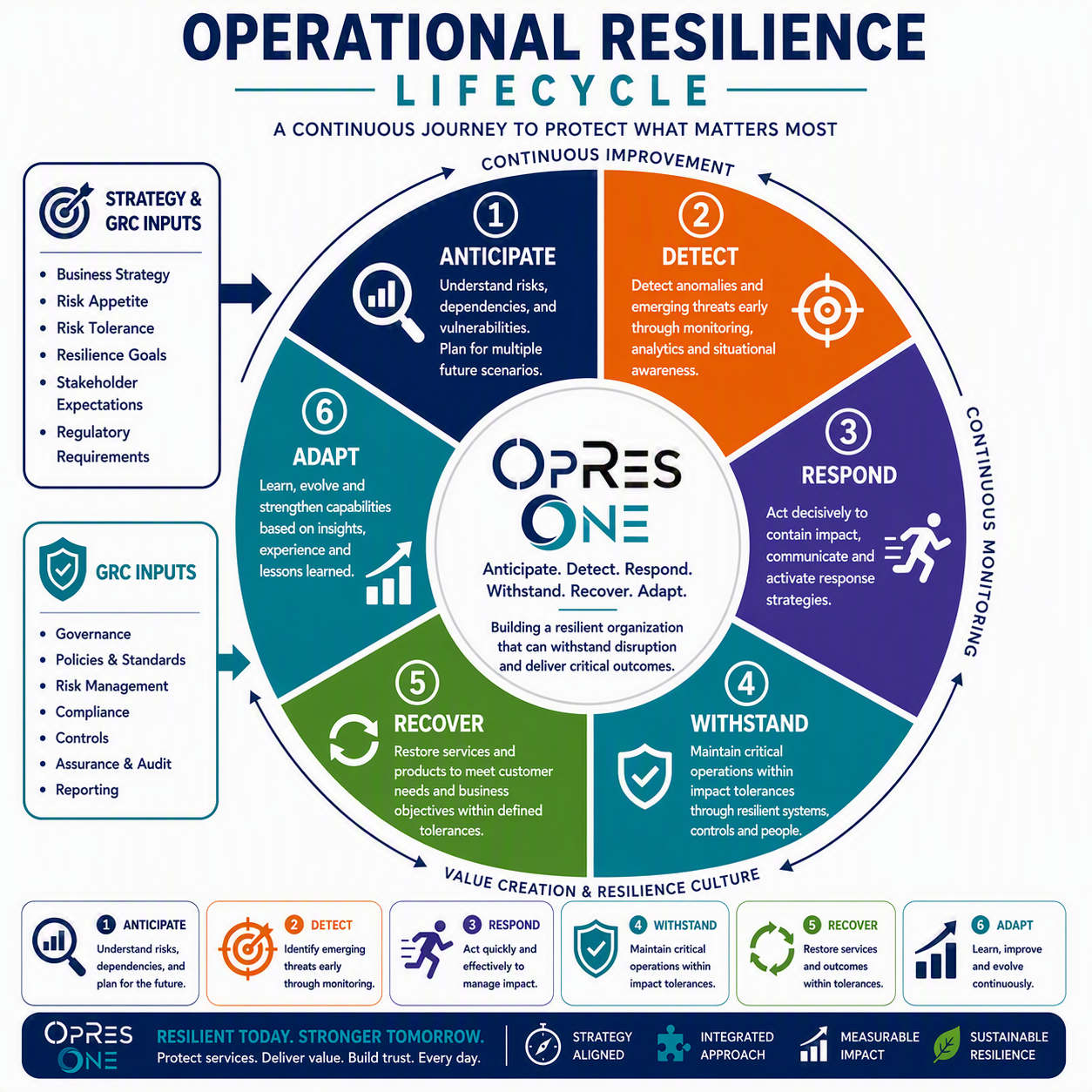
No organization can eliminate every risk. Even with strong governance, mature controls, resilient architectures, and proactive monitoring, disruptions will still occur.
The difference between a contained incident and an organizational crisis often depends on the quality of the response.
The Respond phase focuses on how the organization acts when disruption occurs. It brings together incident response, crisis management, operational decision-making, executive leadership, communications, regulatory awareness, and business continuity coordination.
The goal is not simply to react. The goal is to preserve control, protect stakeholders, maintain confidence, and prevent operational disruption from escalating beyond acceptable tolerances.
The Respond phase asks:
When disruption occurs, can we make the right decisions quickly, communicate effectively, and coordinate action across the enterprise?
Key Inputs
Response activities depend on current, accurate, and decision-ready information, including:
- Incident alerts
- Detection triggers
- Escalation criteria
- Crisis management plans
- Incident response plans
- Business continuity plans
- Cyber incident playbooks
- Communications templates
- Regulatory notification requirements
- Stakeholder contact lists
- Critical service maps
- Impact tolerance thresholds
- Supplier escalation contacts
- Executive decision protocols
- Situation reports
- Legal and compliance guidance
These inputs help response teams understand what happened, what is affected, who needs to act, and what decisions are required.
Lifecycle Process
A mature Respond process establishes clear roles, repeatable workflows, and coordinated decision-making.
Core response activities include:
1. Recognize and Classify the Event
Determine whether the event is an operational incident, cyber event, supplier disruption, technology outage, compliance issue, crisis, or combined event.
2. Escalate Based on Impact
Use severity levels and impact tolerance thresholds to determine when leadership, crisis teams, regulators, customers, or suppliers must be engaged.
3. Activate Response Structures
Mobilize incident response teams, crisis management teams, business continuity teams, technology recovery teams, communications teams, and executive leadership as needed.
4. Develop a Common Operating Picture
Establish a shared understanding of what happened, what services are impacted, what dependencies are affected, and what actions are underway.
5. Make Timely Decisions
Enable executives and operational leaders to make informed decisions regarding service prioritization, resource allocation, customer communication, workarounds, recovery sequencing, and risk acceptance.
6. Communicate Clearly and Consistently
Coordinate internal, external, customer, supplier, regulator, media, and executive communications.
7. Track Actions and Decisions
Maintain decision logs, action registers, situation updates, and evidence for post-incident review.
Key Outputs
The Respond phase should generate structured, auditable outputs such as:
- Incident classification record
- Situation reports
- Crisis management meeting records
- Decision logs
- Action trackers
- Stakeholder communication notices
- Regulatory notification records
- Executive briefings
- Service impact assessments
- Escalation reports
- Response timeline
- Supplier coordination records
- Customer communication updates
- Incident containment documentation
- Transition plan to Withstand or Recover activities
Why This Phase Matters
Poor response creates secondary damage. Confusion, delayed escalation, conflicting communication, unclear leadership, and undocumented decisions can increase operational, reputational, legal, and regulatory exposure.
A strong response capability allows organizations to act with discipline under pressure. It ensures that teams know their roles, executives receive meaningful information, customers receive appropriate communication, and critical services remain the central focus.
OpResONE Perspective
At OpResONE, we help organizations integrate crisis management, cyber incident response, business continuity, disaster recovery, supplier coordination, and executive decision-making into a single response model.
This is critical because real disruptions do not respect organizational silos. A cyber incident may become a customer service issue. A supplier failure may become a regulatory issue. A technology outage may become an executive crisis.
Operational resilience requires response structures that are integrated, practiced, and aligned to critical outcomes.
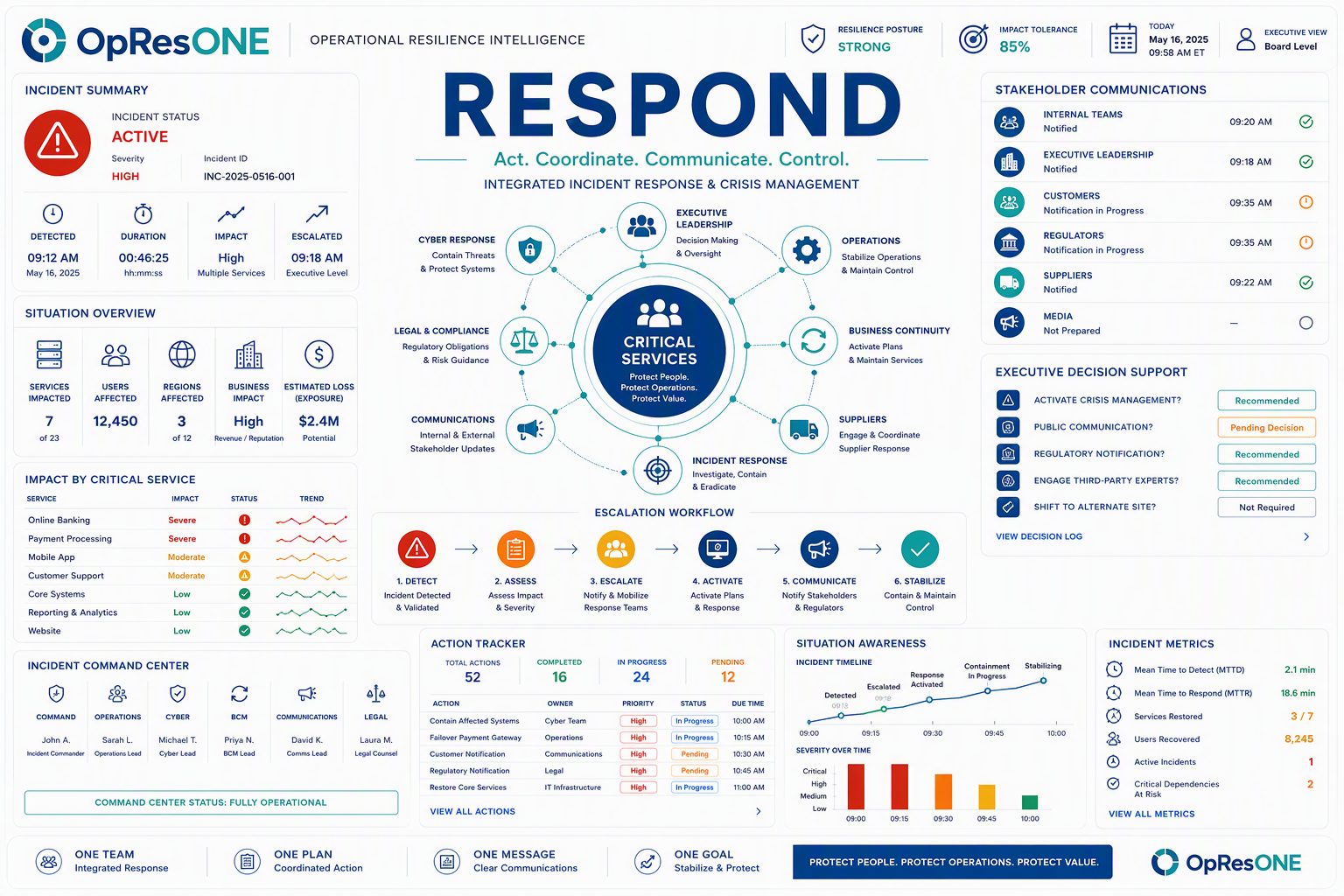
*Possible Integrated Dashboard


Add comment