




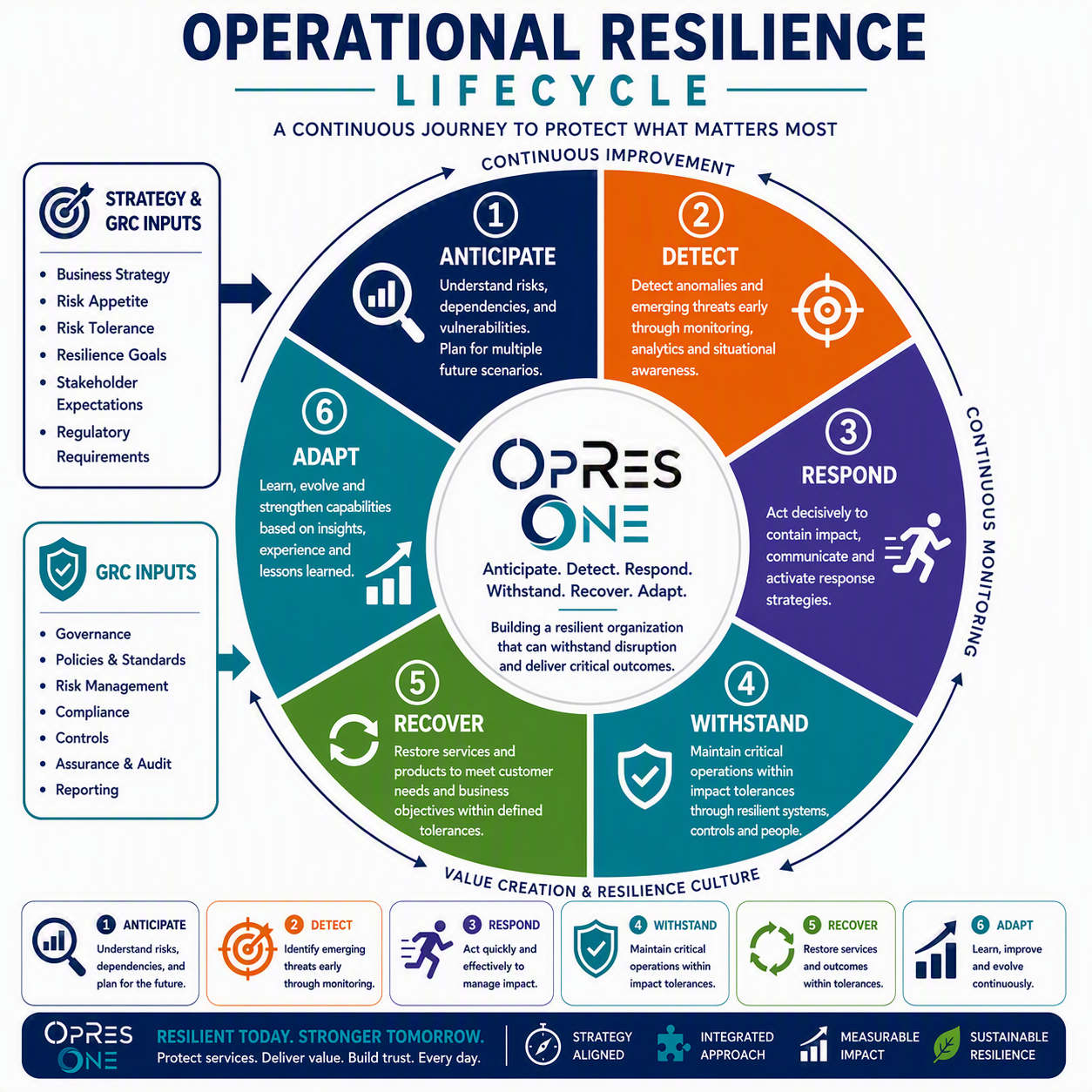
Even the most resilient organizations can experience disruptions that exceed preventative controls or operating capacity. When this happens, recovery capabilities become essential.
The Recover phase focuses on restoring critical services, business operations, technology, communications, customer outcomes, and stakeholder confidence within defined impact tolerances.
Recovery is often associated with business continuity and disaster recovery. While these disciplines remain essential, operational resilience expands recovery beyond restoring systems or relocating work. Recovery must be aligned to business priorities, customer expectations, regulatory obligations, and impact tolerance thresholds.
The Recover phase asks:
Can we restore critical services and outcomes before disruption causes unacceptable harm?
Key Inputs
The Recover phase depends on information and capabilities developed throughout the lifecycle, including:
- Business continuity plans
- Disaster recovery plans
- Critical service maps
- Recovery time objectives
- Recovery point objectives
- Impact tolerance thresholds
- Technology restoration procedures
- Application dependency maps
- Data backup and restoration procedures
- Manual workaround procedures
- Crisis communication plans
- Supplier recovery commitments
- Workforce recovery strategies
- Customer communication templates
- Regulatory notification requirements
- Incident response documentation
- Situation reports and decision logs
These inputs guide recovery sequencing, restoration priorities, communication needs, and validation activities.
Lifecycle Process
A strong recovery process ensures restoration efforts are organized, prioritized, tested, and aligned to critical outcomes.
Core recovery activities include:
-
Confirm service impact and recovery priorities
Determine which services, systems, processes, customers, and dependencies are affected. -
Align recovery to impact tolerances
Prioritize restoration based on customer harm, regulatory exposure, financial loss, operational dependency, and strategic importance. -
Activate recovery plans
Execute business continuity, disaster recovery, technology restoration, supplier recovery, facility recovery, or manual workaround procedures. -
Coordinate across business and technology teams
Ensure business operations, IT, cybersecurity, suppliers, communications, and leadership remain aligned. -
Communicate recovery status
Provide timely updates to employees, customers, executives, regulators, suppliers, and other stakeholders. -
Validate restoration
Confirm that systems, data, processes, controls, and service outcomes are functioning as required. -
Transition to steady-state operations
Move from recovery mode back to controlled operations while monitoring for residual issues.
Key Outputs
The Recover phase should produce documented and validated outputs such as:
- Recovery activation records
- Business continuity execution logs
- Disaster recovery execution logs
- Service restoration reports
- Technology recovery validation results
- Data restoration confirmation
- Customer communication updates
- Regulatory communication records
- Recovery timeline
- Impact tolerance breach analysis
- Recovery metric reports
- Residual risk assessment
- Transition to normal operations checklist
- Post-incident review package
Why This Phase Matters
Recovery is not simply returning to normal. It is restoring value, confidence, and control.
If recovery activities are not aligned to critical services, organizations may restore the wrong systems first, overlook customer impact, miss regulatory obligations, or fail to validate that service outcomes are truly restored.
Operational resilience requires recovery to be business-led, risk-informed, technology-enabled, and tolerance-driven.
OpResONE Perspective
At OpResONE, we help organizations connect traditional BCM and disaster recovery capabilities to the broader operational resilience lifecycle. Recovery should not exist in isolation. It should be informed by Anticipate, triggered by Detect, coordinated through Respond, strengthened by Withstand, and improved through Adapt.
This integrated approach ensures recovery activities are not merely technical exercises, but strategic capabilities that preserve organizational value.
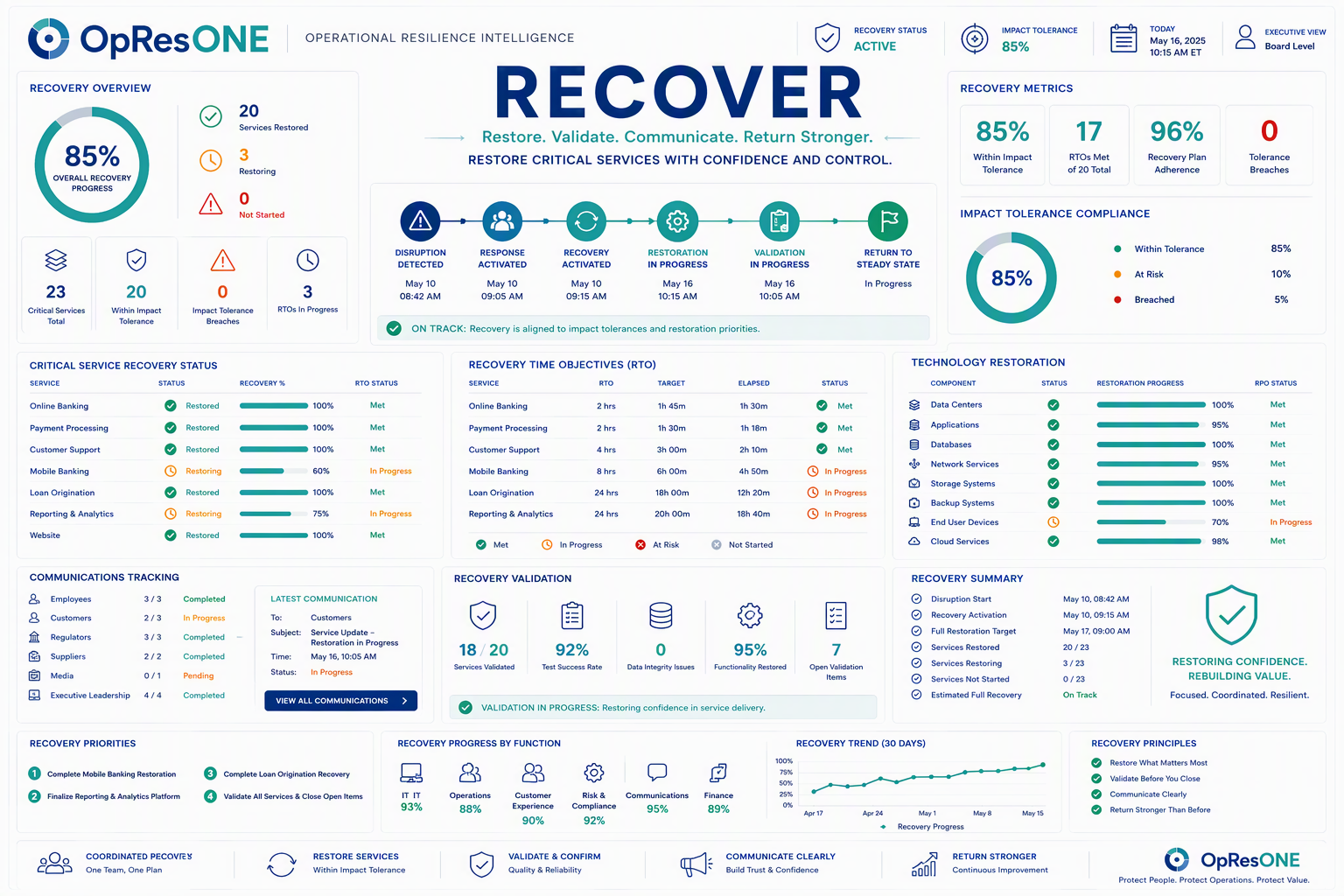
*Possible Integrated Dashboard


Add comment