




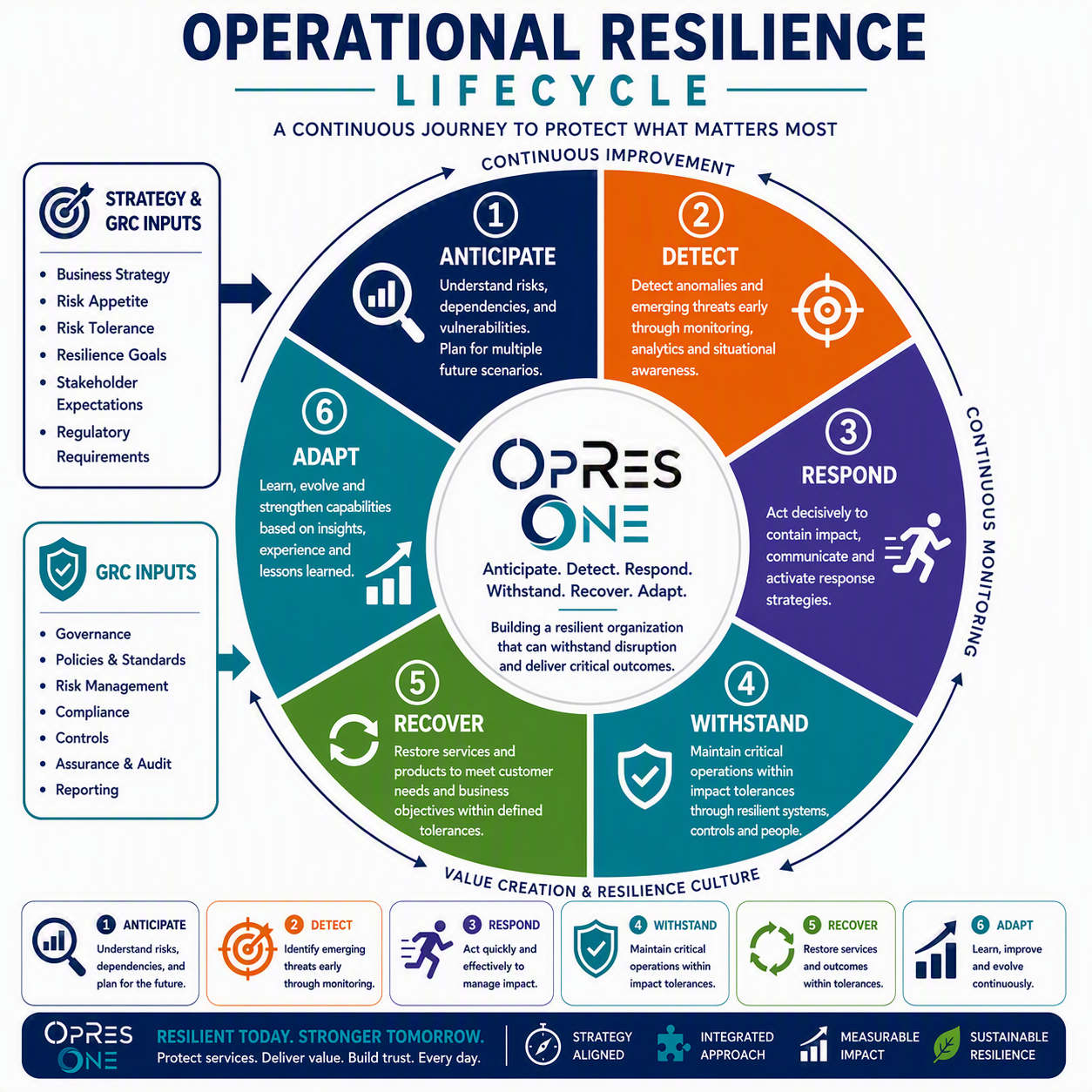
Business continuity has traditionally focused on recovery. Operational resilience expands the conversation.
Instead of asking only, “How quickly can we recover?” organizations must also ask:
Can we continue delivering critical services while disruption is still happening?
That is the purpose of the Withstand phase.
Withstand focuses on the organization’s ability to absorb operational stress, continue critical service delivery, and prevent disruption from exceeding impact tolerances. It is the phase where resilience becomes embedded into operating models, technology design, supplier arrangements, workforce strategies, controls, and governance.
A resilient organization is not one that merely restores service after failure. It is one that can continue operating through disruption.
Key Inputs
The Withstand phase builds on information from Anticipate, Detect, and Respond, including:
- Critical service maps
- Impact tolerance statements
- Dependency assessments
- Control effectiveness results
- Technology architecture reviews
- Cybersecurity posture assessments
- Supplier resilience assessments
- Workforce availability plans
- Capacity management data
- Process-level risk assessments
- Business continuity strategies
- Disaster recovery capabilities
- Incident response results
- Operational performance monitoring
- Risk treatment plans
- Executive risk appetite
These inputs help determine where resilience must be strengthened to maintain operations during disruptive conditions.
Lifecycle Process
The Withstand phase focuses on designing and sustaining operational capabilities that reduce exposure and increase durability.
Core activities include:
-
Strengthen critical service dependencies
Improve the resilience of people, processes, technology, facilities, data, suppliers, and controls that support important services. -
Reduce single points of failure
Address fragile dependencies, unsupported systems, concentrated vendor relationships, manual bottlenecks, and key-person risks. -
Design resilient operating models
Embed alternate workflows, cross-training, workload shifting, remote operations, surge capacity, and decision authority into business operations. -
Enhance technology resilience
Improve availability, redundancy, failover capabilities, backup architecture, cyber defenses, identity controls, data protection, and system monitoring. -
Improve supplier resilience
Validate supplier continuity, concentration risk, fourth-party dependencies, service-level commitments, substitution options, and escalation protocols. -
Test ability to operate under stress
Conduct scenario testing, tabletop exercises, cyber simulations, supplier disruption exercises, capacity tests, and operational stress tests. -
Align controls to resilience outcomes
Evaluate whether controls are not only compliant, but effective in preserving critical service delivery during disruption.
Key Outputs
The Withstand phase should produce practical resilience-strengthening outputs such as:
- Resilient operating model design
- Single point of failure remediation plan
- Service continuity strategy
- Supplier resilience improvement plan
- Technology resilience enhancement plan
- Cyber resilience control map
- Workforce resilience plan
- Operational redundancy strategy
- Capacity and surge plan
- Control effectiveness report
- Scenario testing results
- Resilience investment roadmap
- Executive resilience risk acceptance report
Why This Phase Matters
Withstand is where operational resilience becomes more than documentation. It becomes operational durability.
An organization may have recovery plans, but if critical services fail immediately under stress, the damage may already be done. Customers may lose access. Regulators may raise concerns. Employees may lack direction. Suppliers may fail to perform. Technology may not support alternate operations.
Withstand reduces the likelihood that disruption will become catastrophic.
OpResONE Perspective
At OpResONE, we view Withstand as one of the most important distinctions between traditional BCM and operational resilience. BCM often focuses heavily on recovering business processes after disruption. Operational resilience requires organizations to design services so they can continue operating during disruption.
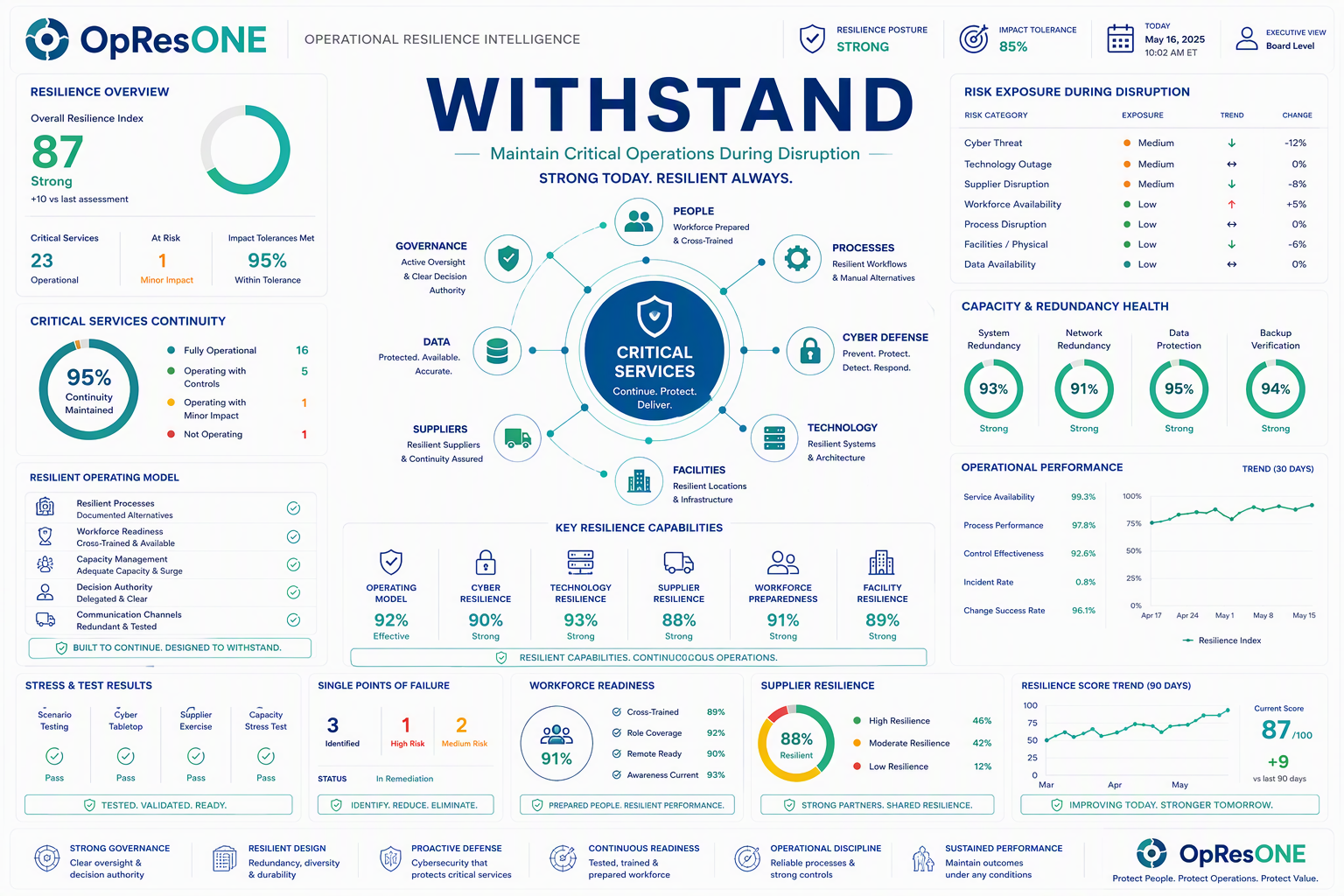
This requires integration across GRC, cyber, technology, operations, third-party risk, enterprise risk, crisis management, and executive governance.
*Possible Integration Dashboard


Add comment