




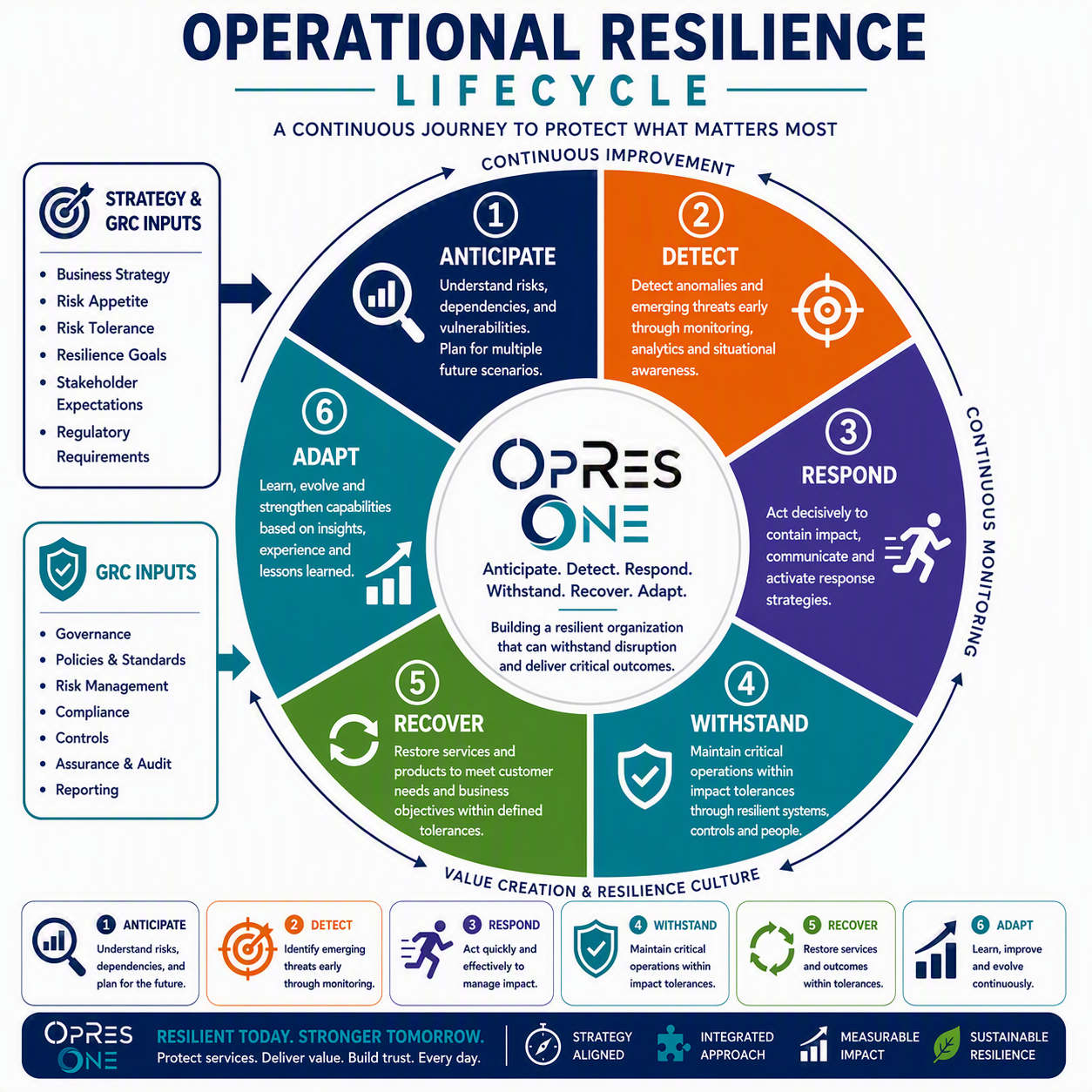
Traditional business continuity programs often activate after something has already gone wrong.
Operational resilience requires a more proactive approach.
The Detect phase focuses on identifying early warning signs before a risk becomes a disruption, before a disruption becomes a crisis, and before a crisis causes unacceptable harm.
Detection is about visibility. It transforms operational data, risk indicators, control results, supplier signals, performance trends, cyber alerts, and incident intelligence into actionable awareness.
In an integrated GRC framework, detection connects monitoring activities across the organization. Instead of viewing cyber alerts, supplier risks, compliance issues, operational metrics, and incident reports separately, organizations begin to understand how these signals affect critical services and strategic outcomes.
The Detect phase asks:
What is changing, deteriorating, failing, or emerging that could threaten our ability to deliver critical services?
Key Inputs
Effective detection depends on access to meaningful and timely information, including:
- Key Risk Indicators
- Key Performance Indicators
- Key Control Indicators
- Cybersecurity alerts
- Threat intelligence feeds
- Supplier performance metrics
- Service-level agreement performance
- Incident reports
- Audit findings
- Compliance exceptions
- Control testing results
- Process performance data
- Technology monitoring data
- Customer complaints
- Operational loss events
- Business continuity test results
- Third-party risk monitoring results
These inputs help the organization identify patterns, anomalies, and emerging threats.
Lifecycle Process
The Detect phase establishes monitoring capabilities that allow leadership and operational teams to see risk movement in near real time.
A strong Detect process typically includes:
- Define meaningful indicators
Establish KRIs, KPIs, KCIs, and threshold triggers aligned to critical services and impact tolerances.
-
Monitor critical dependencies
Track people, process, technology, supplier, facility, data, and control dependencies that support important business services. -
Integrate cyber and operational signals
Connect cybersecurity events, system performance degradation, supplier disruptions, and operational incidents into a consolidated resilience view. -
Identify early warning thresholds
Define when performance degradation becomes a resilience concern and when escalation is required. -
Automate reporting where possible
Leverage GRC platforms, dashboards, workflow tools, and monitoring systems to reduce manual effort and improve timeliness. -
Escalate emerging threats
Route risk signals to the appropriate operational, technical, risk, compliance, continuity, or executive audience. -
Validate signal quality
Review false positives, missed indicators, delayed reporting, and unclear thresholds to improve detection maturity.
Key Outputs
The Detect phase should produce outputs that enable timely awareness and action, including:
- Resilience dashboard
- KRI and KPI register
- Early warning indicator framework
- Service health monitoring reports
- Supplier monitoring alerts
- Cyber and operational threat reports
- Control exception reports
- Incident trend analysis
- Threshold breach notifications
- Escalation reports
- Executive resilience scorecards
- Operational risk heat maps
- Emerging risk register
- Detection playbooks
Why This Phase Matters
The earlier an organization detects a threat, the more response options it has available. Early detection may allow the organization to prevent an incident, reduce impact, activate contingency procedures, notify leadership, engage suppliers, shift workloads, or preserve capacity before disruption escalates.
Without detection, organizations are forced into reactive response. They may not know a service is degrading until customers complain, regulators inquire, systems fail, or business operations are interrupted.
OpResONE Perspective
At OpResONE, we believe detection is where GRC data becomes operational intelligence. The real value of risk and compliance information is not just documentation. It is the ability to identify when risk is increasing and when intervention is required.
Detection allows organizations to move from static reporting to continuous resilience monitoring.
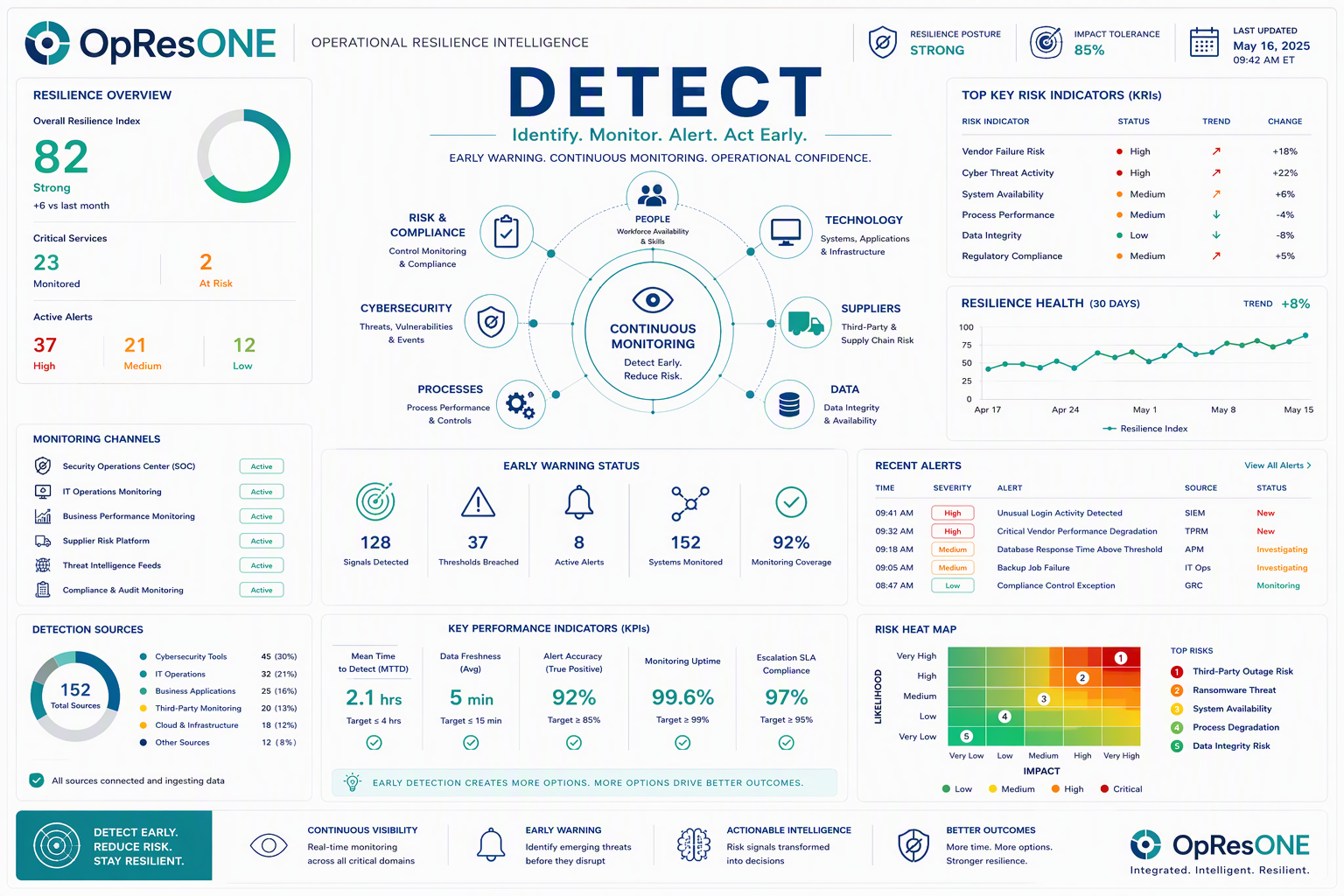
*Possible Dashboard Mockup


Add comment