




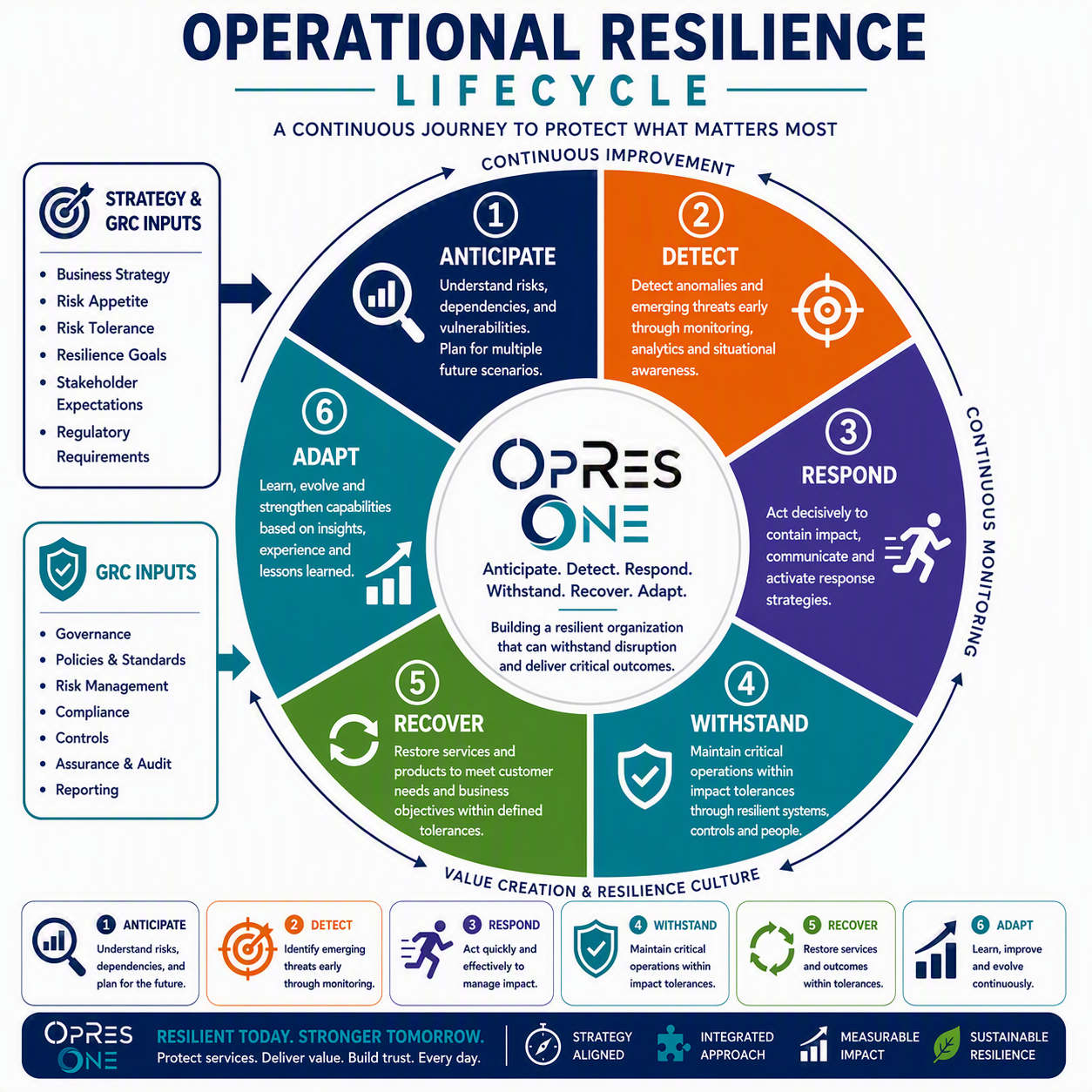
Operational resilience does not begin when a crisis occurs. It begins much earlier, when an organization takes the time to understand what could prevent it from achieving its strategic objectives, delivering critical services, or maintaining stakeholder confidence.
The Anticipate phase is the foundation of the operational resilience lifecycle. It focuses on developing organizational visibility before disruption occurs. This is where strategy, governance, risk intelligence, business impact analysis, dependency mapping, compliance obligations, cybersecurity posture, third-party dependencies, and operational risk converge into a single view of what matters most.
Many organizations already perform risk assessments, business impact analyses, vendor reviews, cyber assessments, and continuity planning. The challenge is that these activities are often performed independently. Risk teams assess enterprise threats. Business continuity teams document recovery requirements. Cybersecurity teams evaluate technical vulnerabilities. Procurement teams assess suppliers. Compliance teams monitor regulatory obligations.
Operational resilience connects these activities around one central question:
What could prevent the organization from continuing to deliver its most important products, services, and outcomes?
Key Inputs
The Anticipate phase relies on structured information from across the organization, including:
- Enterprise strategy and business objectives
- Critical products and services
- Important business services
- Business impact analysis results
- Process maps and service maps
- Technology and application inventories
- Data dependencies
- Third-party and supplier relationships
- Regulatory and compliance obligations
- Risk registers and audit findings
- Cybersecurity assessments
- Control effectiveness results
- Prior incident and disruption history
- Impact tolerance thresholds
- Executive risk appetite statements
These inputs help establish the operational resilience baseline. Without them, organizations risk building continuity plans or recovery strategies around incomplete assumptions.
Lifecycle Process
During the Anticipate phase, the organization identifies what is critical, what could go wrong, where dependencies exist, and where weaknesses may affect service delivery.
A mature Anticipate process typically includes:
-
Define critical services and outcomes
Identify the products, services, processes, and outcomes that matter most to customers, regulators, stakeholders, and the organization. -
Map end-to-end dependencies
Connect services to people, processes, technology, data, facilities, suppliers, applications, infrastructure, and controls. -
Assess threats and vulnerabilities
Evaluate internal and external risks, including cyber events, supplier failure, technology outages, workforce disruption, regulatory exposure, geopolitical tension, fraud, and operational process breakdown. -
Evaluate impact tolerances
Determine how much disruption the organization can absorb before customer harm, financial loss, regulatory breach, or strategic damage becomes unacceptable. -
Identify single points of failure
Locate fragile dependencies, manual workarounds, unsupported technologies, insufficient staffing models, weak controls, and concentrated supplier risk. -
Translate uncertainty into action
Convert assessment findings into prioritized resilience actions, roadmap initiatives, risk treatments, and governance decisions.
Key Outputs
The Anticipate phase should produce practical, decision-ready outputs such as:
- Critical service inventory
- Important business service register
- Business impact analysis report
- Dependency maps
- Impact tolerance statements
- Operational risk profile
- Vulnerability and single-point-of-failure analysis
- Third-party dependency register
- Cyber and technology resilience assessment
- Control gap analysis
- Scenario planning results
- Resilience maturity assessment
- Executive risk and resilience briefing
- Prioritized resilience improvement roadmap
Why This Phase Matters
Organizations cannot protect what they do not understand. Anticipation gives leadership the intelligence needed to make informed decisions before operational failures emerge.
A strong Anticipate capability helps organizations move from reactive continuity planning to proactive operational resilience management. It provides the evidence base for investment, governance, risk treatment, testing, and executive oversight.
OpResONE Perspective
At OpResONE, we view Anticipate as the point where GRC becomes operationally meaningful. Governance, risk, compliance, continuity, cyber, and third-party data must be connected to critical business outcomes. When properly integrated, this intelligence enables leaders to understand not only what risks exist, but how those risks could affect the organization’s ability to deliver value.
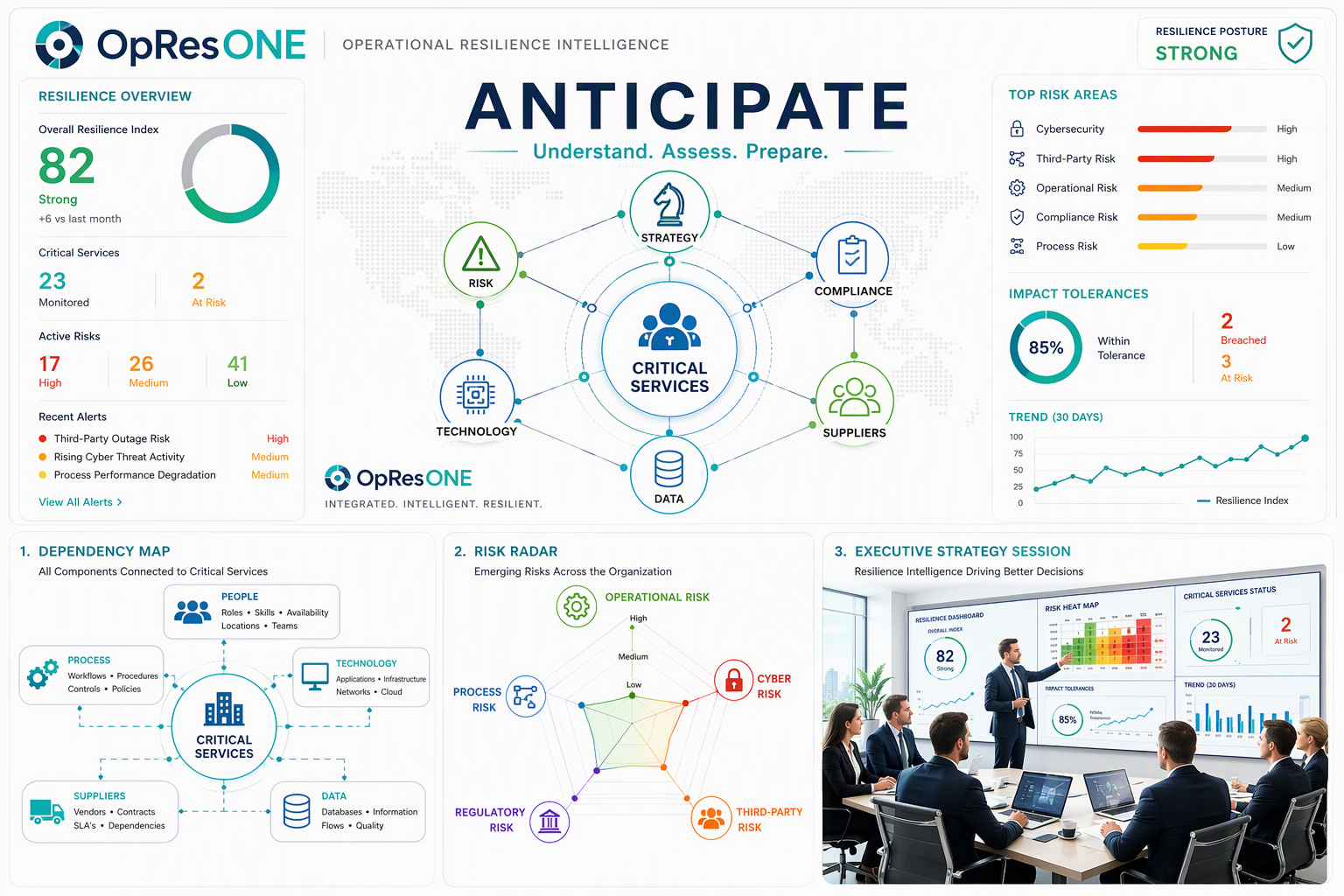
*Potential Dashboard for Management:


Add comment