



We offerSOLUTIONSfor our clients!
THE CHALLENGE
Boards are asking harder questions than ever before.
- Can our critical services survive a cyberattack?
- How exposed are we to third-party failures?
- Who is accountable for AI risk?
- Can we demonstrate operational resilience to regulators?
- How do all of these risks connect?
- Where should we invest next?
Unfortunately, many organizations cannot answer these questions with confidence.
- Not because they lack risk programs.
- Not because they lack compliance activities.
- Not because they lack technology.
They struggle because critical programs operate in isolation.
How OpResONE Helps Senior Executives Deliver What the Board Demands
At OpResONE, we believe resilience is not a program.
It is a business capability.
It is a Culture!
Our methodology aligns governance, risk, compliance, operational resilience, cybersecurity, third-party risk, crisis management, and executive reporting around one central question:
What services matter most to the organization, and can they continue operating during disruption?
Instead of building additional standalone programs, we establish a unified operating model that connects people, processes, technology, data, risks, controls, vendors, and governance structures into a single resilience framework.
The OpResONE Connect360™ Approach
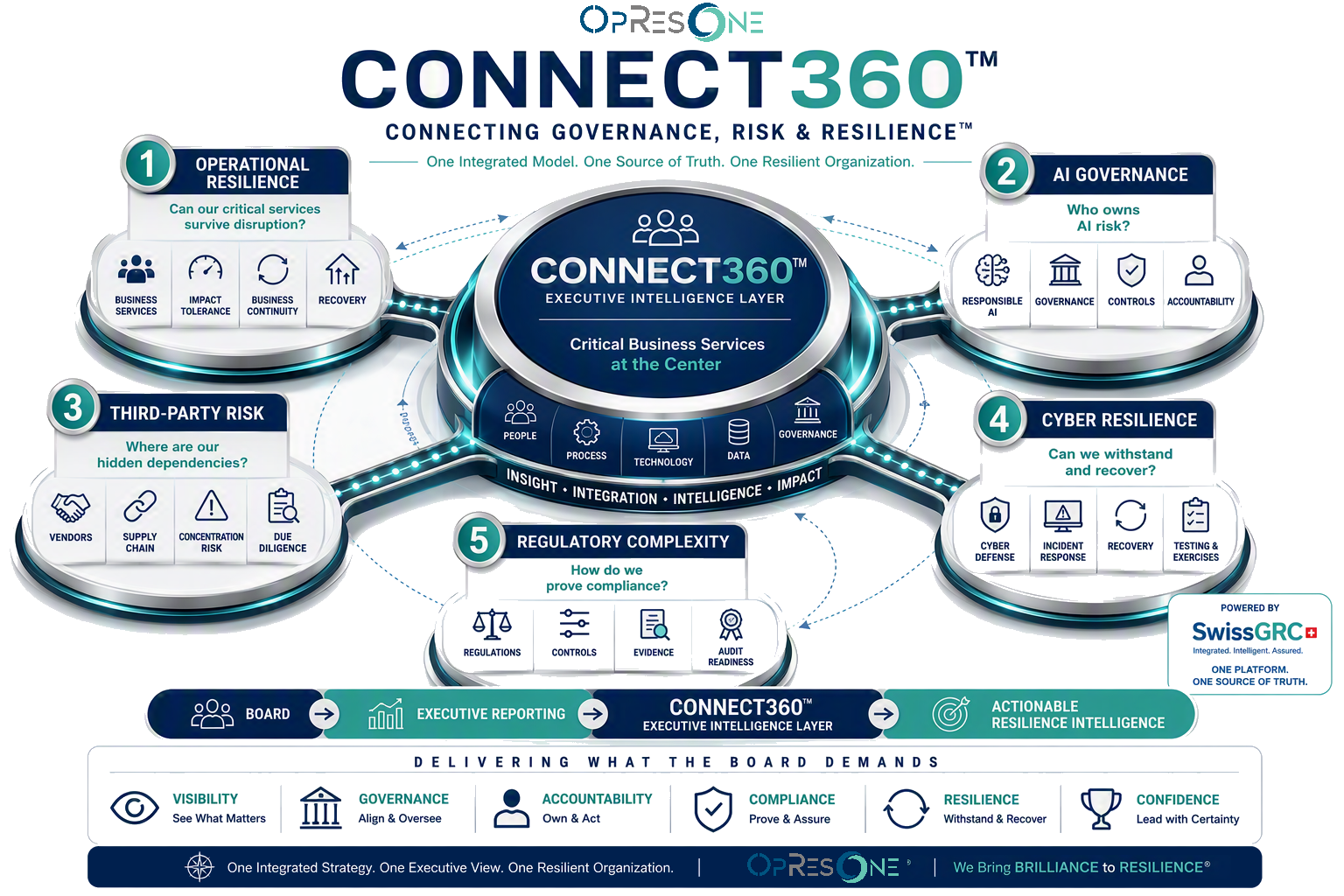
1-Operational Resilience
Protecting Critical Business Services
Most organizations focus on systems, applications, or departments.
We focus on business services.
OpResONE helps organizations:
Identify Critical Services
We work with leadership teams to define the services that customers, regulators, shareholders, employees, and stakeholders depend upon.
Map Service Dependencies
We connect:
- Processes
- Applications
- Data
- Facilities
- Vendors
- Personnel
- Controls
to the services they support.
Establish Impact Tolerances
We help executives define:
- Maximum tolerable downtime
- Service disruption thresholds
- Customer impact expectations
- Recovery objectives
Validate Resilience Through Testing
Our team designs and facilitates:
- Scenario testing
- Crisis exercises
- Recovery simulations
- Tabletop exercises
- Executive decision exercises
The result is clear visibility into where resilience truly exists and where investment is required.
3-Third Party Risk Management
Understanding Dependencies BEFORE they become failures
Many organizations underestimate how dependent they are on vendors, service providers, cloud platforms, and supply chain partners.
A single vendor failure can disrupt multiple business services simultaneously.
OpResONE helps organizations:
Build Service-Centric Vendor Inventories
Instead of merely tracking suppliers, we connect vendors directly to:
- Critical services
- Applications
- Processes
- Recovery dependencies
Identify Concentration Risk
We highlight:
- High-risk supplier dependencies
- Single points of failure
- Geographic concentrations
- Fourth-party exposures
Improve Oversight
We establish governance around:
- Due diligence
- Risk assessments
- Performance monitoring
- Contract obligations
- Ongoing resilience reviews
Leadership gains visibility into vendor-related disruption risks before they impact operations.
2-AI Governance & Responsible AI
AI Governance & Responsible AI
Creating Accountability Before Regulators Ask
Board members are increasingly asking:
"Who owns AI risk?"
Many organizations have no clear answer.
AI adoption is moving faster than governance.
OpResONE helps organizations create practical and auditable AI governance programs by establishing:
AI Governance Frameworks
We define:
- Roles and responsibilities
- Governance committees
- Oversight processes
- Escalation procedures
AI Risk Management
We help identify and manage risks involving:
- Bias
- Explainability
- Hallucinations
- Model changes
- Privacy concerns
- Intellectual property exposure
- Human oversight requirements
Policy & Control Development
We develop:
- AI policies
- Standards
- Control libraries
- Risk acceptance criteria
- Monitoring requirements
Executive Reporting
We provide leadership with meaningful metrics that demonstrate AI governance effectiveness and regulatory preparedness.
4-Cyber Resilience
Moving Beyond Prevention
Most cybersecurity programs focus on preventing attacks.
Boards want confidence that the organization can recover when prevention fails.
OpResONE helps organizations connect cybersecurity to operational resilience by answering:
- Which services are exposed?
- What happens if a critical platform fails?
- Can we recover in time?
- Are recovery capabilities tested?
Integrated Cyber Resilience Planning
We align:
- Security controls
- Incident response
- Business continuity
- Disaster recovery
- Crisis management
around critical services.
Scenario-Based Testing
We conduct exercises involving:
- Ransomware attacks
- Cloud service failures
- Insider threats
- Supply chain disruptions
- Technology outages
Executive Cyber Reporting
Executives receive service-level intelligence, not technical metrics alone.
This helps leadership understand potential business impact rather than simply reviewing threat statistics.
5-Regulatory Complexity
Transforming Compliance into Strategic Intelligence
Many organizations struggle under growing regulatory requirements.
Teams manage:
- DORA
- NIS2
- ISO 22301
- ISO 27001
- SOC
- PCI DSS
- HIPAA
- SOX
- Privacy regulations
- Industry-specific mandates
Often separately.
The result is duplicated effort and fragmented reporting.
OpResONE helps unify obligations into a single governance model that links:
- Requirements
- Policies
- Risks
- Controls
- Evidence
- Testing
- Findings
- Remediation activities
This allows organizations to demonstrate compliance while simultaneously improving resilience.
Our Vision
To establish OpResONE, Inc. as the leading provider of an integrated resilience framework, ensuring that our clients can withstand and adapt to disruptions through a unified approach encompassing EPM, ERP, Governance, Risk, and Compliance (GRC), Business Continuity, IT Application Recovery, Emergency Management, Crisis Management, and Incident Management.