Resilience Before Recovery
Why Operational Resilience Should Lead the Enterprise Program, While Business Continuity Executes Recovery and Adaptation
Executive White Paper | Prepared for OpResONE and SwissGRC Program Conversations
Executive Summary
Boards and executive teams increasingly recognize that disruption is no longer an episodic exception. Cyber events, vendor failures, infrastructure outages, workforce constraints, regulatory scrutiny, geopolitical change, and technology concentration have made disruption a normal operating condition. The common executive response has been to mature business continuity, disaster recovery, crisis management, cyber incident response, and GRC reporting. These disciplines are necessary, but they are often managed as separate programs. The result is a collection of plans rather than a coherent capability to keep important business services inside acceptable tolerances when conditions are adverse.
This white paper argues for a sharper executive distinction. Resilience must come before the Anticipate and Withstand phases because resilience is the precondition that makes those phases meaningful. An organization cannot credibly anticipate severe but plausible scenarios unless critical services, dependencies, risk appetite, impact tolerances, third parties, technology assets, controls, and governance obligations are already understood as one operating system. An organization cannot withstand disruption unless controls, recovery options, communication roles, capacity assumptions, and service priorities are built into how the business runs before the event. Resilience is therefore a design principle, a management system, and an operating posture.
Business Continuity (BCM Business Continuity Management), by contrast, is at its strongest during Recover and Adapt. Continuity plans, recovery procedures, alternate workarounds, crisis communications, and post-event lessons learned are essential once the organization is already in a disruptive event or is emerging from one. BCM helps restore products and services within acceptable timeframes and at predefined capacity. That mission is indispensable, but it is not the same as engineering the enterprise to be resilient before the shock occurs. Treating BCM as the whole resilience answer delays the most important work until too late in the lifecycle.
The practical answer is an integrated program model. SwissGRC's GRC Toolbox provides the digital foundation for a shared inventory of risks, controls, policies, assets, incidents, vulnerabilities, suppliers, processes, audit findings, and resilience activities. OpResONE provides the consulting discipline to translate that platform into an operating program, aligning business leaders, technology leaders, risk owners, compliance stakeholders, and continuity professionals around one management model. Together, platform plus advisory power creates a home run capability: simplified management, single-source governance, faster executive visibility, and measurable improvement across resilience and continuity.
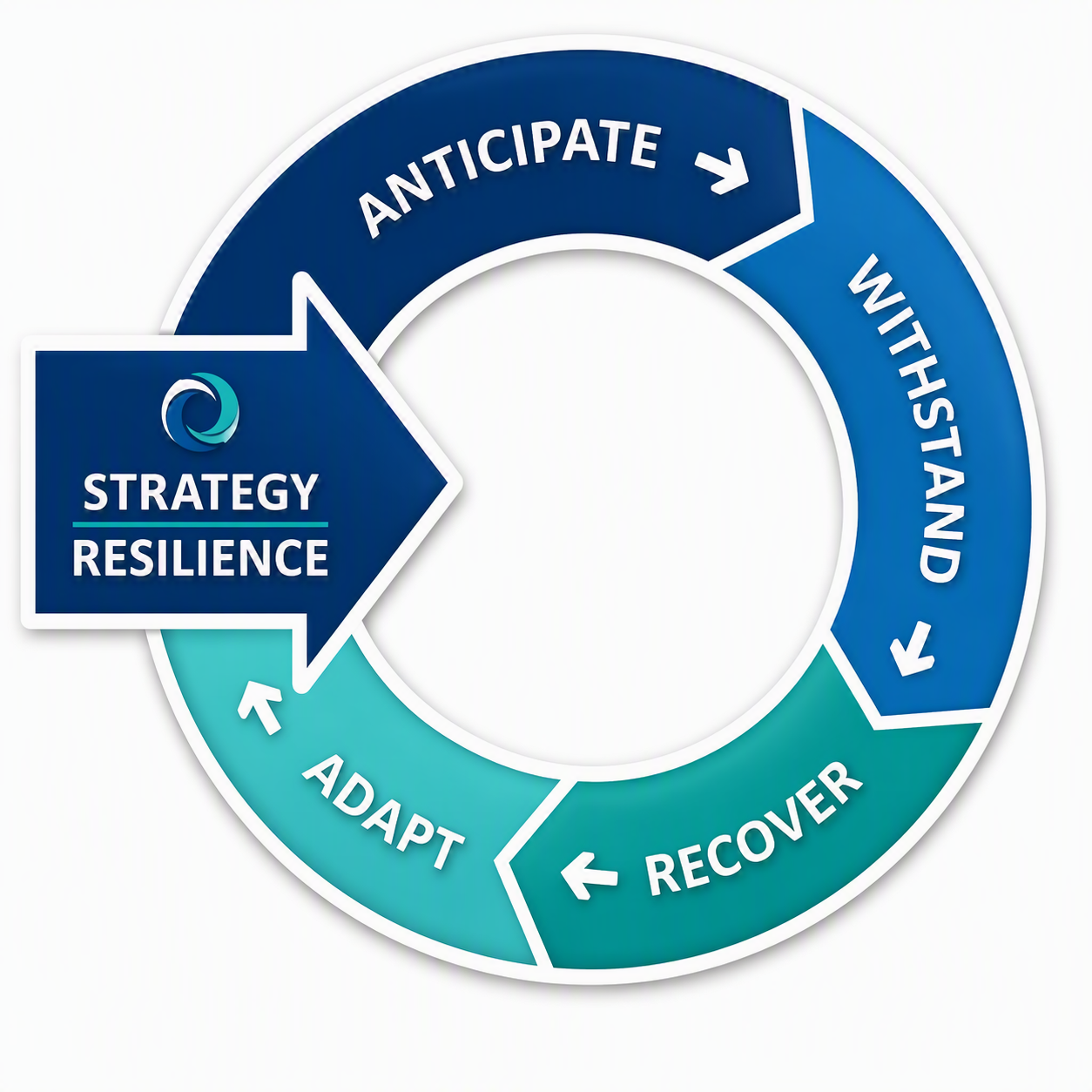 The Operating Sequence
|
1. Resilience Foundation
|
2. Anticipate
|
3. Withstand
|
4. Recover and Adapt
|
The key management insight is that resilience is the foundation that precedes and enables Anticipate and Withstand. Business Continuity then becomes the disciplined execution layer for Recover and Adapt, connected back into resilience through lessons learned, control improvements, and scenario refinement.
1. The Strategic Problem: Plans Are Not the Same as Resilience
Many organizations have made substantial investments in continuity plans, cyber incident response playbooks, disaster recovery runbooks, vendor segmentation, policy libraries, risk registers, and compliance attestations. Yet executives still struggle to answer simple operational questions under pressure. Which products and services matter most? Which customers, contracts, and regulatory obligations are attached to those services? Which applications, data stores, facilities, people, suppliers, and control activities support those services? Which disruptions would be tolerable, which would be damaging, and which would threaten the enterprise promise? If those questions cannot be answered quickly before a crisis, the enterprise does not yet have resilience. It has documentation.
The distinction matters because disruption does not respect organizational charts. A ransomware event may begin in technology, trigger regulatory reporting obligations, interrupt operations, expose vendor weaknesses, require customer communications, stress liquidity, and create board-level decisions within hours. A severe weather event may start as a facilities problem and quickly become a workforce availability, supply chain, customer delivery, and data accessibility problem. A third-party outage may appear to be contract risk, but the business impact is felt through service commitments, complaint volumes, revenue leakage, and reputational damage. Workstreams built in functional silos cannot provide enterprise clarity fast enough.
Traditional BCM often begins with the Business Impact Analysis, plan templates, recovery strategies, and exercises. That remains valuable, but the approach can accidentally frame continuity as a planning function rather than a strategic management capability. The BIA identifies critical activities, recovery time objectives, dependencies, and resource needs, but if those data points remain isolated from enterprise risk management, compliance obligations, control testing, technology asset management, and third-party risk, leaders receive fragments of the truth. Resilience requires those fragments to be normalized into a shared operating picture.
The executive challenge is therefore not whether business continuity is important. The executive challenge is where business continuity belongs in the lifecycle. If BCM is treated as the umbrella term for all resilience, then the program tends to over-focus on recovery documentation. If resilience is treated as the enterprise condition that makes anticipation and endurance possible, then BCM becomes a critical downstream capability that executes recovery and adaptation within a broader management architecture. This reframing raises the strategic maturity of the whole program.
2. Resilience Comes Before Anticipate and Withstand
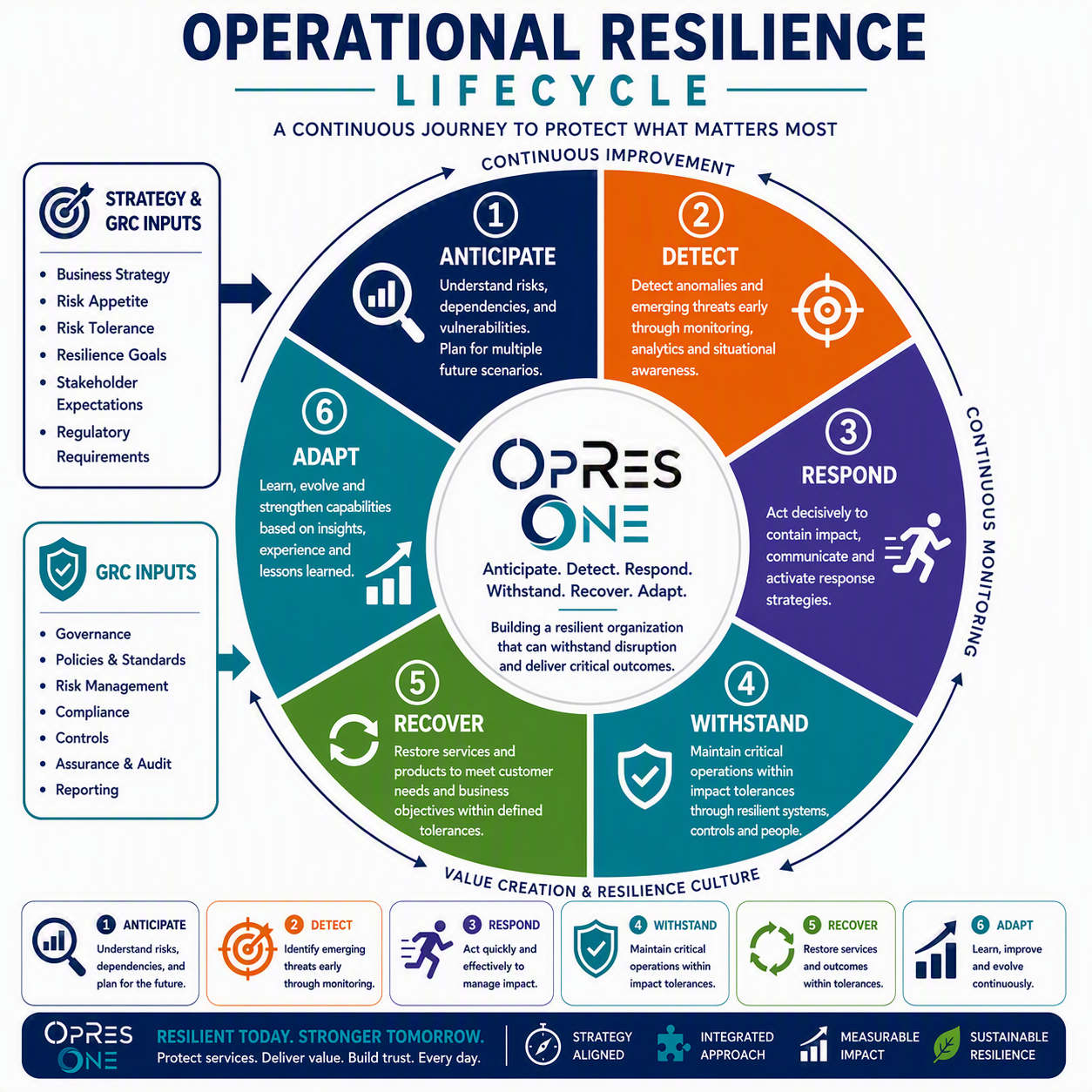
The phrase anticipate, withstand, recover, and adapt is powerful because it describes what a resilient organization must be able to do. NIST defines cyber resiliency as the ability to anticipate, withstand, recover from, and adapt to adverse conditions, stresses, attacks, or compromises involving cyber resources. The sequence is useful, but executives should not mistake the words for four equal boxes that can be built independently. Anticipate and withstand require a capability base that must already exist. That base is resilience.
Resilience before anticipate means the organization knows what matters before it tries to predict what might happen. Anticipation is not a brainstorming exercise about threats. It is a disciplined analysis of severe but plausible scenarios against important business services and value streams. To anticipate well, leaders must know the enterprise service catalog, process hierarchy, dependency map, control posture, third-party exposure, technology concentration, data sensitivity, and regulatory consequences. Without that resilient foundation, scenario planning becomes speculative and disconnected from operational reality.
Resilience before withstand means the organization designs endurance into daily operations before stress arrives. Withstand is not heroic improvisation. It is the result of architectural choices, governance decisions, resource allocation, redundancy, manual workaround design, control effectiveness, supplier oversight, crisis escalation, and investment prioritization. A company withstands disruption because critical service teams already know acceptable impact tolerances, because technology teams already know service dependencies, because risk teams already know critical controls, and because executives already know which tradeoffs they are willing to make.
This is why resilience is better for a company than a plan-centered interpretation of continuity. Resilience improves normal operating performance as well as crisis performance. Resilience clarifies accountability, reduces duplicated controls, exposes fragile dependencies, aligns cyber priorities to business services, and gives the board a more concise view of enterprise risk. It also helps the organization allocate capital more intelligently because the investment question changes from How do we recover after disruption? to What must be designed into the enterprise so vital services remain within tolerance?
3. Business Continuity Belongs Primarily in Recover and Adapt
Business Continuity remains one of the most important disciplines in the enterprise resilience ecosystem. ISO 22301 is the international standard for Business Continuity Management Systems and focuses on planning, establishing, implementing, operating, monitoring, reviewing, maintaining, and improving the capabilities needed to protect against, reduce the likelihood of, and ensure recovery from disruptive incidents. That purpose is valuable and necessary. The question is not whether BCM matters. The question is whether BCM should be positioned as the whole resilience strategy or as a critical execution discipline inside a broader resilience operating model.
Recover is the natural home of BCM. Recovery requires procedures, roles, crisis structures, communications, alternate processes, restoration priorities, resource assignments, dependency workarounds, and exercises. BCM creates the map for continuing or restoring products and services within acceptable timeframes and at predefined capacity. When disruption occurs, continuity teams help convert strategy into action. They coordinate with IT disaster recovery, facilities, human resources, legal, communications, operations, customer teams, suppliers, and leadership. They bring discipline to chaos.
Adapt is also a natural BCM contribution because every real incident and exercise should feed lessons realized back into the program. After-action reviews, plan updates, control improvements, training adjustments, scenario revisions, and governance escalations all support adaptation. In a mature program, adaptation is not a document refresh. Adaptation is a management loop that changes risk treatments, technology designs, supplier requirements, policy controls, and executive priorities based on lived evidence.
However, BCM alone cannot carry the full weight of resilience if the upstream foundation is weak. A recovery plan cannot fix missing dependency data, unclear service ownership, untested controls, unknown supplier concentration, fragmented risk acceptance, or technology designs that were never built for endurance. A continuity exercise can reveal those weaknesses, but revealing weaknesses after the fact is more expensive than managing resilience before the incident. BCM should therefore be elevated, not diminished, by placing it where it has the most leverage: Recover and Adapt within a resilience-led lifecycle.
Phase Lifecycle Matrix
|
Lifecycle phase
|
Primary management question
|
Lead capability
|
Key personnel responsible
|
Executive evidence
|
Resilience Foundation
|
What must be true before disruption?
|
Operational resilience and GRC integration
|
Chief Risk Officer (CRO), Chief Resilience Officer, COO, GRC Director, Enterprise Architecture Lead, Business Service Owners, Compliance Officer
|
Service map, dependency map, tolerances, controls, ownership
|
Anticipate
|
What could threaten vital services?
|
Scenario analysis, risk, cyber intelligence
|
CRO, CISO, Threat Intelligence Manager, Enterprise Risk Manager, Third-Party Risk Manager, Business Service Owners, Regulatory Affairs Lead
|
Severe but plausible scenarios tied to business impact
|
Withstand
|
Can services remain within tolerance?
|
Controls, architecture, suppliers, response readiness
|
CIO, CISO, Infrastructure Director, Security Operations Manager, Vendor Management Lead, Operations Director, Control Owners, Facilities Manager
|
Action plans, control tests, endurance metrics
|
Recover and Adapt
|
How do we restore and improve?
|
BCM, DR, crisis management, lessons learned
|
BCM Manager, IT Disaster Recovery Lead, Crisis Management Team Lead, Incident Commander, Communications Director, HR Lead, Executive Leadership Team
|
Plan activation, results, after-action improvements
|
4. Why Resilience Is Better for the Company
Resilience is better for the company because resilience is an enterprise management capability, not merely a response function. A resilient company improves the quality of decision-making before, during, and after disruption. Leaders can see which services carry the highest customer, financial, operational, legal, and reputational consequences. Risk owners can connect controls to the services those controls protect. Technology leaders can prioritize architecture and recovery investments based on business importance rather than system popularity. Compliance leaders can demonstrate that obligations are embedded into operational practices rather than stored in policy repositories.
A resilience-led model also reduces the hidden cost of fragmentation. In many companies, cybersecurity manages vulnerabilities, enterprise risk manages risk registers, compliance manages obligations, internal audit manages findings, procurement manages suppliers, IT manages assets, BCM manages plans, and operations manages process performance. Each discipline may be competent, but the absence of a shared management layer creates duplicated assessments, inconsistent ratings, stale evidence, competing reports, and executive confusion. Resilience demands integration because executives need to see the organization as one system.
 This fragmentation is precisely why a global enterprise platform such as SwissGRC becomes essential. When cybersecurity, enterprise risk, compliance, internal audit, procurement, IT asset management, BCM, and operations each operate from separate tools and reporting cycles, the organization loses the ability to coordinate decisions around the services that matter most. A shared platform creates a common operating layer where risks, controls, obligations, suppliers, assets, incidents, vulnerabilities, continuity plans, recovery actions, and executive evidence are connected to the same business service view. That coordination enables each function to maintain its specialized discipline while contributing to one enterprise resilience picture, giving leadership a reliable way to assign ownership, track accountability, eliminate duplicate effort, and make faster decisions before, during, and after disruption.
Resilience also better matches modern regulatory and customer expectations. Important stakeholders are less impressed by whether an organization has a binder of continuity plans and more interested in whether the organization can prove that important services are governed, dependencies are known, controls are tested, suppliers are managed, impacts are tolerable, and recovery capabilities are exercised. Resilience produces evidence of management. BCM produces evidence of recovery readiness. The strongest organization needs both, but the resilience evidence must come first.
Finally, resilience creates competitive advantage. A company that can absorb disruption, communicate clearly, protect customers, maintain priority services, and learn quickly earns trust. That trust can influence customer retention, regulator confidence, supplier negotiations, insurance discussions, audit outcomes, and board support for investment. In this sense, resilience is not defensive overhead. Resilience is a strategic capability that protects revenue, reputation, and the ability to execute.
5. The Platform Requirement: Why Spreadsheets Cannot Sustain Resilience
A resilience-led program cannot be managed at enterprise scale through disconnected spreadsheets, static documents, email evidence, and periodic status decks. Those tools can launch a program, but they cannot sustain a living understanding of services, risks, assets, controls, obligations, suppliers, vulnerabilities, incidents, actions, and recovery capabilities. The data relationships are too important and too dynamic. When the organization changes, the resilience picture must change with it.
The platform requirement begins with a shared data foundation. Critical services must connect to processes. Processes must connect to applications, data, people, facilities, and suppliers. Risks must connect to controls. Controls must connect to obligations, tests, findings, and issues. Incidents must connect to lessons learned and corrective actions. Continuity plans must connect to services and dependencies rather than exist as isolated files. This relationship model turns resilience from a document library into a management system.
SwissGRC is compelling in this context because the GRC Toolbox is designed to connect governance, risk, compliance, security, and processes on a single platform aligned with business realities. SwissGRC describes the platform as modular and configurable, with GRC disciplines sharing a common data foundation. Its solutions include risk management, information security, internal control systems, data protection, third-party risk management, business continuity management, operational resilience, internal audit, business process modelling, and contract management. This is precisely the architecture needed for simplified management.
A platform does not replace executive judgment, consulting expertise, or operational leadership. It provides the operating infrastructure so those human capabilities are not trapped in disconnected artifacts. The right platform helps leaders answer where risk is concentrated, where controls are weak, where suppliers create service exposure, where policies are stale, where resilience actions are overdue, where recovery assumptions are untested, and where executive decisions are needed. This creates management leverage.
6. The Consulting Requirement: Why OpResONE Adds the Operating Model
Technology alone cannot create resilience. Platform implementation without an operating model often produces a well-configured repository but not a changed management culture. The enterprise must decide what services matter, how risk appetite is expressed, how impact tolerances are set, how controls are rationalized, how data ownership works, how disruptions are escalated, how executives review resilience, and how teams are held accountable. These are consulting, governance, and operating model questions.
OpResONE's value is the ability to translate resilience concepts into practical management routines. That includes executive workshops, maturity assessment, service mapping, dependency analysis, continuity strategy, GRC alignment, cyber resilience integration, third-party risk integration, incident and crisis workflows, dashboard design, evidence strategy, exercise design, and board-level reporting. The consulting function accelerates platform value because it defines how the organization will use the platform to make decisions, not just store data.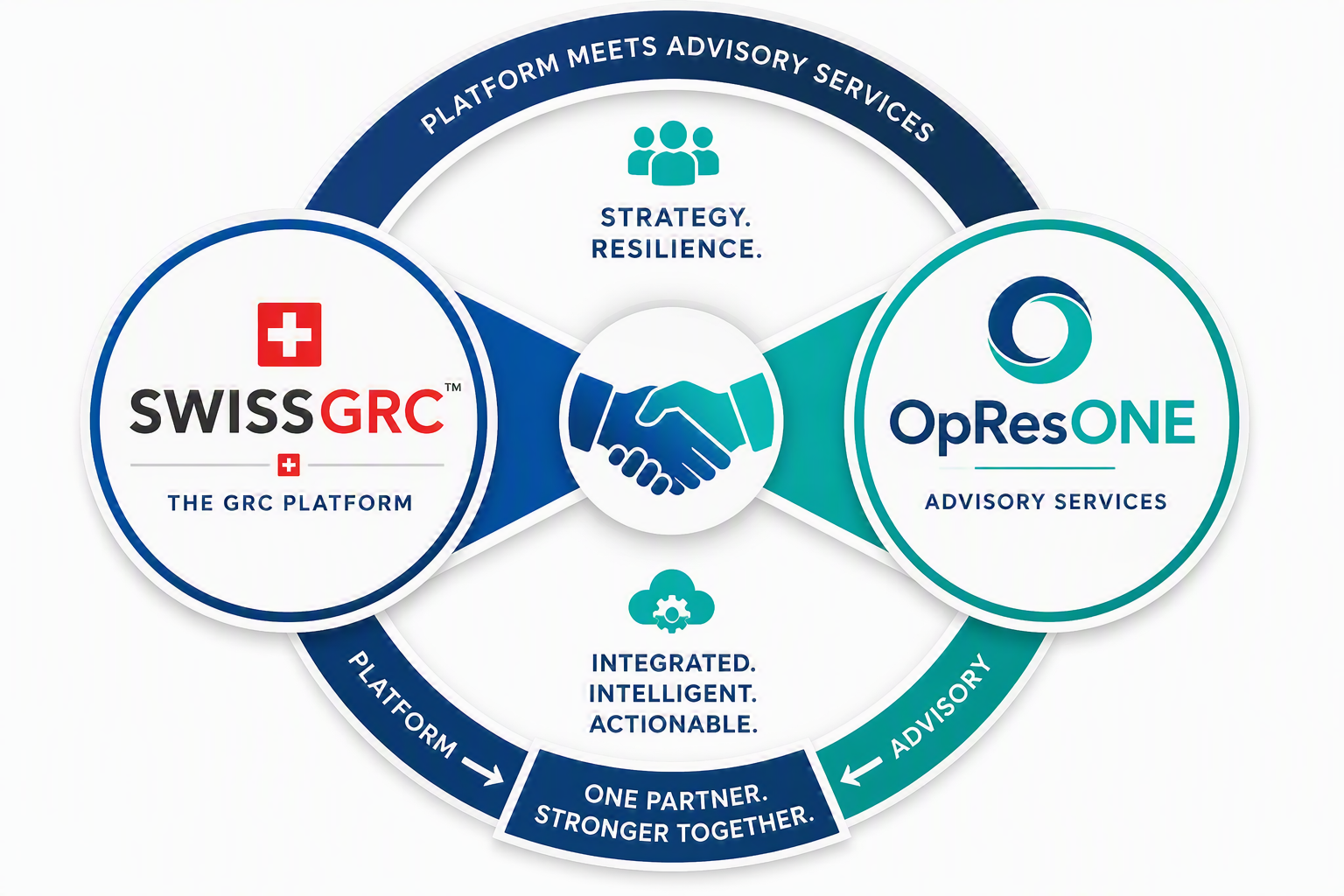
The SwissGRC and OpResONE channel agreement is strategically well aligned with this requirement. SwissGRC and OpResONE are strategically aligned through a channel partnership that combines SwissGRC’s integrated GRC platform with OpResONE’s operational resilience advisory expertise. The announcement specifically positioned OpResONE's role around integration of operational resilience with GRC frameworks and business continuity strategies. That combination maps directly to the thesis of this paper.
A home run capability emerges when platform and consulting are treated as one program. SwissGRC provides the integrated data model, workflow engine, modules, dashboards, and evidence structure. OpResONE provides the advisory playbook, executive facilitation, operating model, implementation sequencing, and resilience interpretation. The client receives not just software and not just advice, but a management capability that can be deployed, adopted, measured, and improved.
7. The Integrated Lifecycle Model
The integrated lifecycle begins with Resilience Foundation. This stage establishes the service catalog, business priorities, impact tolerances, dependency mapping, governance roles, risk taxonomy, control framework, policy structure, supplier segmentation, information security integration, and continuity data standards. The objective is to create one truth about how the organization delivers value and where the organization is fragile. This stage is not a project artifact. It is the baseline operating model.
The Anticipate stage then uses that baseline to identify severe but plausible scenarios. Because services and dependencies are already mapped, leaders can evaluate cyber, technology, facility, supplier, workforce, data, regulatory, and geopolitical scenarios against real business consequences. Anticipation becomes more than threat awareness. It becomes business-calibrated scenario intelligence. Risk treatments can then be prioritized based on measurable service impact rather than generic likelihood and impact scoring.
The Withstand stage turns anticipation into endurance. Controls, alternate processes, technical resilience patterns, supplier commitments, staffing models, communication scripts, and authority matrices are tested against the scenarios. Vulnerabilities become actions. Actions become accountable work. Dashboards show progress. Executives can see whether important services are becoming more resilient or whether residual risk remains outside appetite. Withstand therefore depends on the resilience foundation and bridges into continuity execution.
The Recover and Adapt stage is where BCM, disaster recovery, crisis management, and incident response execute. Plans are activated, services are restored, customers and regulators are informed, and workarounds are managed. After the event, lessons learned are incorporated into the platform. Controls are updated, risks are re-rated, suppliers are remediated, recovery strategies are revised, and scenarios are improved. Adaptation closes the loop by strengthening the resilience foundation for the next cycle.
8. Governance and Executive Visibility
A resilience-led program must be governed at the right level. If resilience is managed only as an operational task, executives see activity but not risk. If resilience is managed only as a board topic, practitioners see pressure but not clarity. The operating model needs tiered governance. Service owners manage service-level resilience. Risk and control owners manage treatment and evidence. BCM and cyber teams manage recovery and incident readiness. Senior executives manage appetite, investment, prioritization, and unresolved tradeoffs. The board receives a concise view of resilience posture, material exposures, and improvement trajectory.
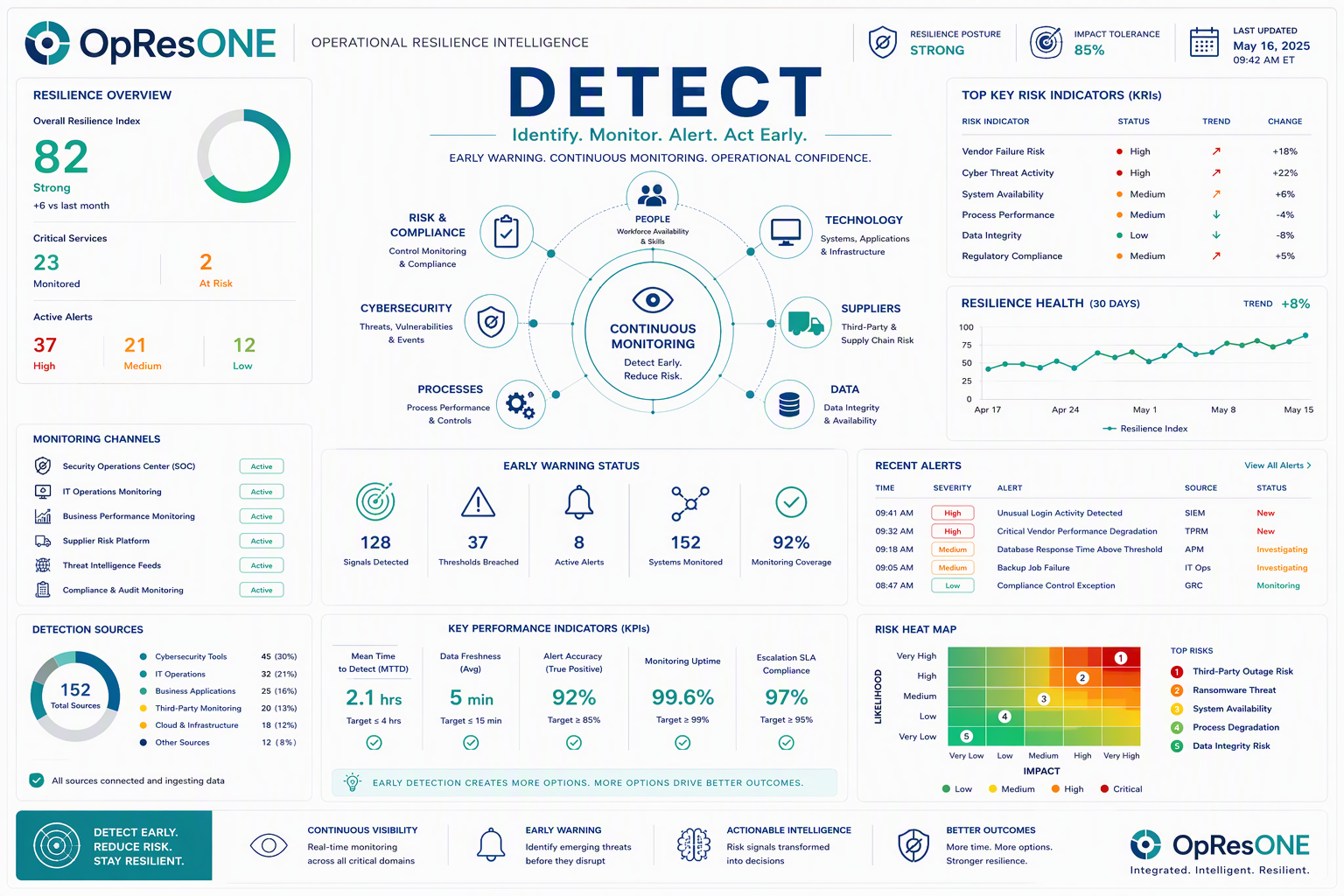
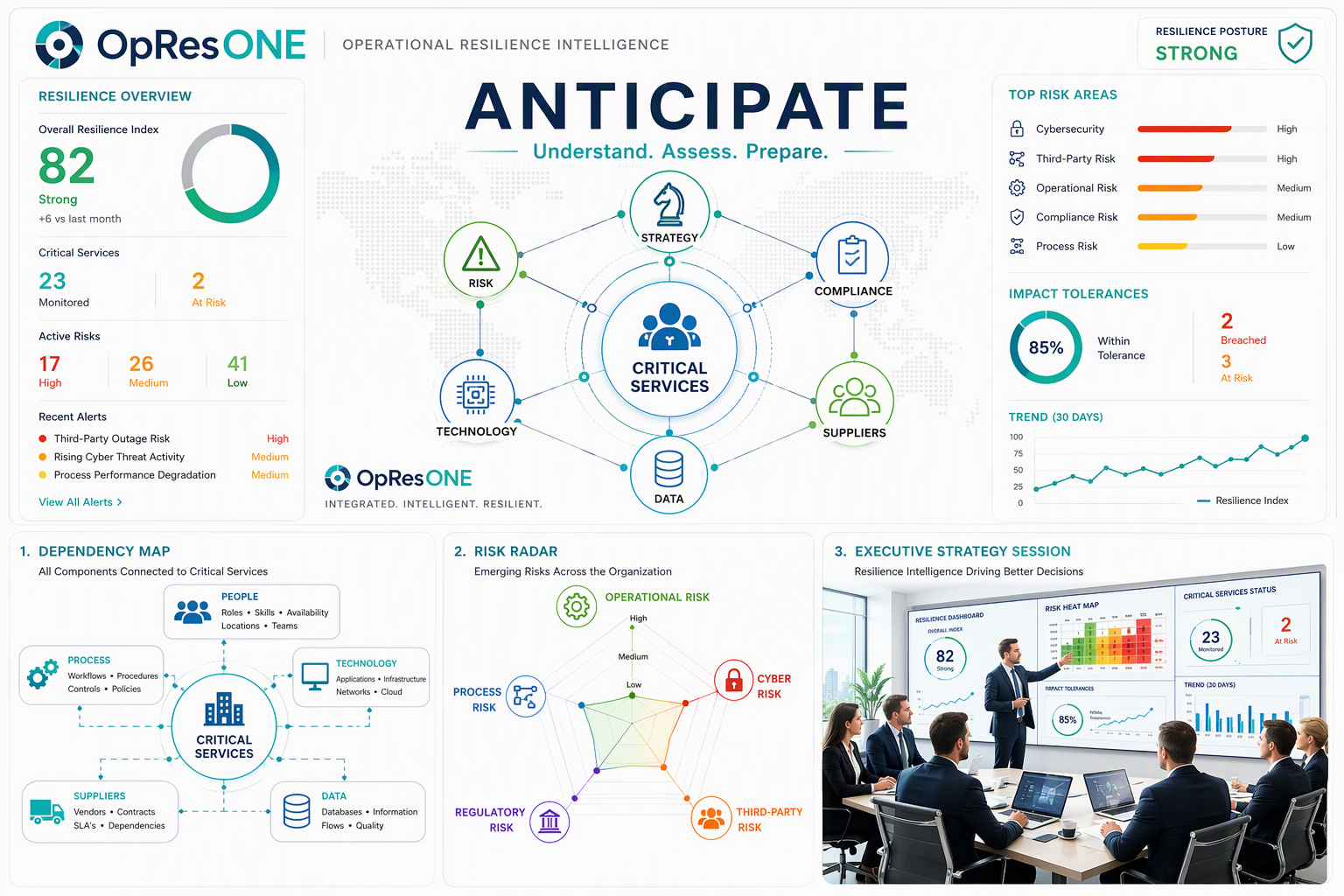
The most useful executive dashboard is not a collection of plan completion percentages. A stronger dashboard shows important business services, impact tolerances, dependency health, critical control effectiveness, third-party exposure, incident trends, recovery capability, open resilience actions, audit findings, and risk decisions. Plan status matters, but plan status is only one indicator. A plan can be complete and still be wrong if dependencies are stale or if the service has changed.
SwissGRC's value here is the ability to bring multiple modules into one reporting ecosystem. OpResONE's value is defining which indicators matter and how leaders should interpret them. Together, the program can move from compliance reporting to management reporting. The executive question becomes not Did we update the plan? but Are our important services within tolerance, and where must we invest, accept, transfer, or reduce risk? That is a much better conversation.
Governance also supports culture. When leaders repeatedly ask resilience-centered questions, the organization learns that resilience is not a side program. Product owners begin thinking about service tolerances. Technology leaders begin aligning architecture to business priorities. Procurement begins treating supplier resilience as a service dependency issue. Compliance begins mapping obligations to operational evidence. BCM teams become strategic partners rather than document owners.
9. Program Management: The Home Run Capability
The phrase home run capability is appropriate because the combined model solves multiple executive problems at once. It simplifies management by reducing tool fragmentation. It improves resilience by mapping services to risks, controls, suppliers, and recovery capabilities. It strengthens GRC by making compliance and control evidence operationally meaningful. It supports cyber resilience by connecting cyber resources to business impact. It elevates BCM by positioning continuity where it creates the most value, in recovery execution and adaptive improvement.
Program management is the difference between a collection of initiatives and an enterprise capability. The program should have a defined roadmap, module sequencing, adoption plan, data governance model, stakeholder map, metrics, meeting rhythm, reporting cadence, training model, and benefits realization plan. The first wave may focus on resilience foundation, risk management, business impact data, and dependency mapping. The second wave may add continuity plans, third-party segmentation, incident workflows, and control assessments. The third wave may expand dashboards, audit integration, policy management, and advanced scenario analysis.
A platform like SwissGRC allows the roadmap to be modular rather than overwhelming. Organizations can begin with the capability that matters most and expand as maturity grows. This is critical because resilience transformation can fail when organizations try to boil the ocean. OpResONE can help sequence the program around business value, regulatory pressure, executive urgency, and organizational readiness. The result is practical maturity rather than theoretical perfection.
The home run is not simply buying technology or writing a better continuity plan. The home run is creating a durable capability that changes how the company sees itself. The company moves from silo views to service views, from static documents to living data, from compliance activity to management insight, from reactive recovery to designed resilience, and from fragmented evidence to simplified management.
Combined Capability Model
|
SwissGRC Platform
|
OpResONE Advisory Power
|
Client Outcome
|
|
Shared data foundation
|
Operating model design
|
One management view
|
|
Risk, controls, BCM, resilience, ISMS, TPRM modules
|
Service mapping and executive facilitation
|
Faster adoption and better decisions
|
|
Workflow, dashboards, evidence, reporting
|
Implementation sequencing and program governance
|
Simplified management and measurable maturity
|
|
Modular expansion path
|
Board-ready narrative and metrics
|
Sustainable resilience plus continuity capability
|
10. Implementation Roadmap
A practical roadmap begins with executive alignment. Leaders should agree on the thesis, scope, outcomes, decision rights, and measures of success. The program sponsor should be empowered to connect risk, technology, operations, compliance, procurement, audit, and BCM. The first workshop should define important business services and the executive questions the program must answer. This prevents configuration decisions from becoming disconnected from business value.
The second step is to establish the resilience data model. This includes critical services, processes, applications, data, facilities, people, suppliers, controls, obligations, recovery objectives, impact tolerances, risks, and incidents. The data model should be pragmatic. Perfect data is not required at launch, but ownership and quality rules are required. A platform makes the model sustainable because data elements are connected and updated through workflows rather than manually reconciled across files.
The third step is to configure priority modules and workflows. Risk management, operational resilience, BCM, ISMS, third-party risk, policy, internal controls, and audit can be activated in a sequence that matches the client's needs. Early wins should include service dashboards, dependency maps, top risk views, control status, continuity plan linkage, issue tracking, and executive reporting. The goal is to show visible management value quickly.
The fourth step is to exercise and improve. Scenarios should test the relationship among resilience foundation, anticipate, withstand, recover, and adapt. Exercises should not merely validate plans. Exercises should validate whether leaders can make decisions, whether service tolerances are understood, whether supplier dependencies are visible, whether cyber incidents translate into business impact, and whether actions are tracked to completion. Adaptation should then update the platform and the operating model.
11. Risks of Not Reframing the Program
The cost of not reframing resilience is growing. Organizations that rely on fragmented continuity documents may find that plans are outdated when needed most. Organizations that rely on cyber tools without business service context may overinvest in technical risk reduction that does not match business priority. Organizations that rely on GRC platforms without operational resilience thinking may produce compliance evidence but miss service fragility. Organizations that rely on consultants without an integrated platform may receive good advice that is hard to sustain.
A second risk is executive fatigue. Boards and senior leaders are frequently presented with overlapping reports from risk, cyber, compliance, audit, continuity, and technology. Each report may be accurate within its domain, but collectively they can obscure the truth. A resilience-led platform model reduces that fatigue by showing how the domains connect. It gives executives fewer but better indicators.
A third risk is regulatory and customer credibility. When stakeholders ask how the company ensures continuity of important services, vague references to plans are no longer enough. Companies must show evidence of governance, dependencies, controls, supplier oversight, testing, recovery capability, and improvement. An integrated platform and consulting model creates that evidence as part of normal management routines.
A final risk is missed opportunity. Resilience investments can improve operational performance even when no crisis occurs. Dependency mapping can expose redundancy gaps, supplier concentration, inefficient controls, unclear ownership, and process bottlenecks. Scenario exercises can improve leadership decision making. Control rationalization can reduce burden. Dashboards can accelerate investment decisions. Organizations that treat resilience only as crisis preparation miss these everyday benefits.
12. Conclusion: Resilience First, Continuity Connected
The central argument is simple. Resilience must come before Anticipate and Withstand because resilience is the enterprise capability that makes anticipation and endurance possible. Business Continuity comes most naturally at Recover and Adapt because continuity provides the procedures, coordination, restoration discipline, and improvement loop needed when disruption occurs. Resilience is better for the company because resilience improves daily management, executive visibility, investment decisions, regulatory confidence, customer trust, and crisis performance.
The best program does not diminish BCM. It strengthens BCM by connecting continuity to the full enterprise operating model. Continuity plans become linked to important services, real dependencies, tested controls, supplier commitments, and executive tolerances. Recovery procedures become part of a broader resilience cycle. Lessons learned become changes in risk, controls, architecture, contracts, policies, and scenarios. This is how organizations move from plan ownership to capability ownership.
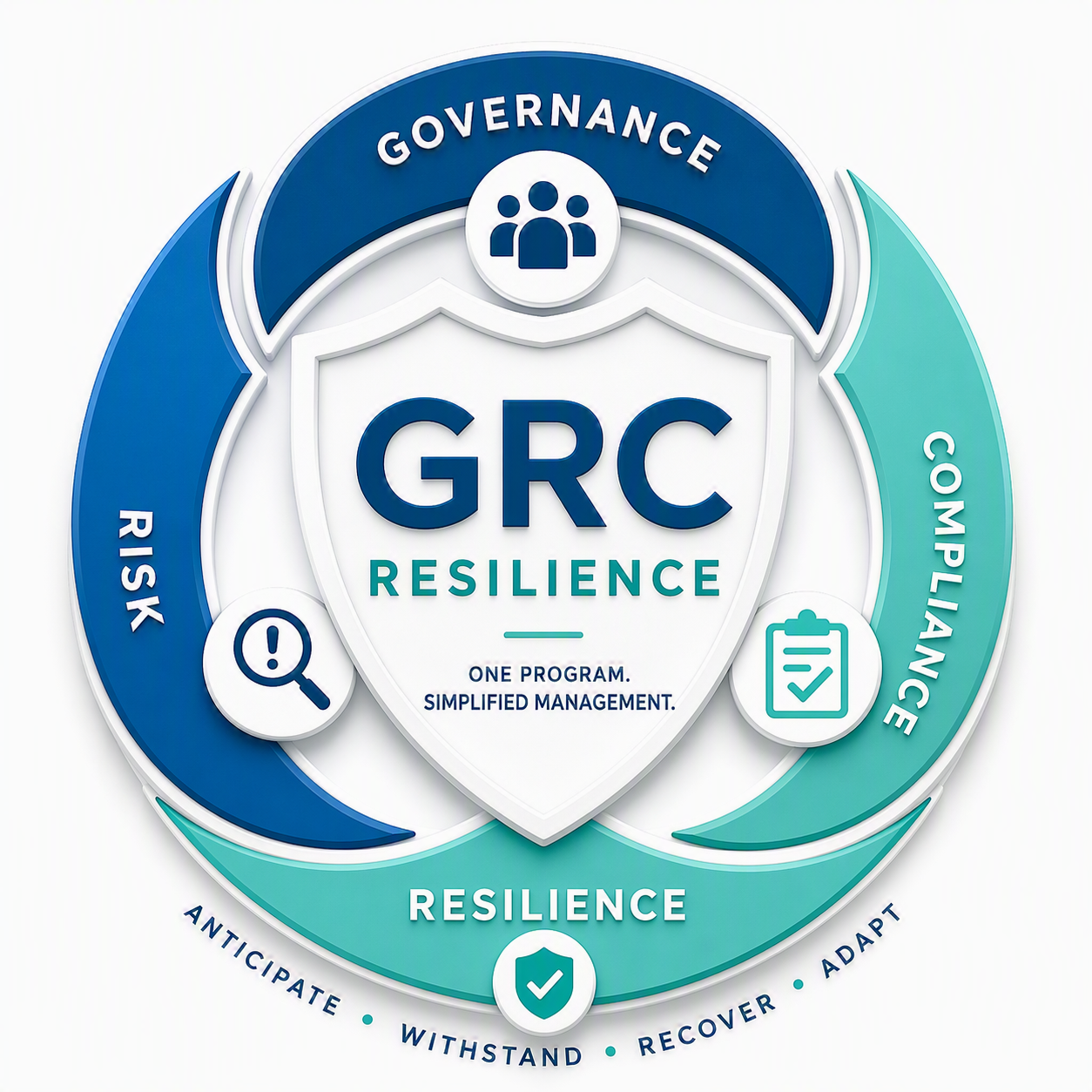
SwissGRC and OpResONE are well positioned for this shift. SwissGRC provides the integrated platform architecture and modular GRC Toolbox needed to manage data, workflows, controls, risks, continuity, operational resilience, information security, and reporting. OpResONE provides the consulting power to design the operating model, align executives, sequence implementation, and translate resilience theory into business practice. Together, they offer a single program story: GRC and Resilience, Simplified Management.
For executives, the recommendation is clear:
Stop asking whether the organization has enough continuity plans. Start asking whether the organization is resilient enough before disruption begins. Then connect BCM to recover and adapt, supported by a platform that makes the program visible, measurable, and sustainable. That is the home run capability.
Selected Sources and Reference Points
1. NIST Computer Security Resource Center, cyber resiliency glossary and NIST SP 800-160 Volume 2 Revision 1, defining cyber resiliency as the ability to anticipate, withstand, recover from, and adapt to adverse conditions, stresses, attacks, or compromises involving cyber resources.
2. ISO 22301:2019, Security and resilience, Business continuity management systems, Requirements, describing a management system to protect against, reduce likelihood of, and ensure recovery from disruptive incidents.
3. SwissGRC, GRC Toolbox and solution pages, describing a modular platform with risk management, information security, internal controls, data protection, third-party risk, business continuity, operational resilience, audit, BPM, and contract management capabilities.
4. SwissGRC and OpResONE partnership announcement, December 4, 2024, describing the strategic partnership to bring SwissGRC GRC solutions to the United States and Canada with OpResONE's operational resilience and regulatory advisory support.
5. OpResONE public SwissGRC Toolbox pages, describing integrated ISMS, risk management, asset management, control assessments, incident management, vulnerability management, policy management, reporting, and modular deployment themes.
Executive Readiness Scorecard
|
Question
|
Good Evidence
|
Program Owner
|
|
Do we know our important services?
|
Approved service catalog with owners and tolerances
|
Executive sponsor and service owners
|
|
Can we anticipate credible disruption?
|
Scenario library linked to services and risks
|
Risk, cyber, operations, OpResONE advisors
|
|
Can we withstand within tolerance?
|
Controls, suppliers, workarounds, and actions tracked
|
Operations, technology, risk owners
|
|
Can we recover and adapt?
|
BCM and DR results linked to lessons learned
|
BCM, crisis management, ITDR
|
|
Can the board see the posture?
|
Dashboard with trends, gaps, decisions, acceptances
|
Program governance office
|
Author
|

|
Joseph Brewer, MBCP, PMP, CCMP, MBA
CEO, OpResONE, Inc.

This email address is being protected from spambots. You need JavaScript enabled to view it.
Master Business Continuity Planner (MBCP)
ISO 22301 Certified Sr. Lead Implementer
ISO 22301 Certified Sr. Lead Auditor
ISO 31000 Certified Sr. Risk Manager
ISO 27035 Certified Sr. Lead Incident Manager
D.O.R.A. Senior Lead Manager
Senior Lead Operational Resilience Manager
ISO Certified Trainer for PECB
 Book time to meet with me Book time to meet with me
|